5 Essential Tips for Athens Changing of the Guard With Kids
There’s a good chance this post contains affiliate links. This means that if you purchase anything through one of our links, we’ll receive a small fee (it won’t cost you anything, promise!). As an Amazon Affiliate, we earn from qualifying purchases. If you would like to learn more about our affiliate partners, click here for our disclaimer.
If you’ve searched for the best things to do in Athens with kids, you’ve probably seen the same advice everywhere:
“Don’t miss the Changing of the Guard at Syntagma Square.”
And yes — it is impressive.
But here’s the thing:
What most travel guides don’t tell you is how crowded, loud, and surprisingly intense this experience can feel, especially if you’re travelling with neurodivergent children (or if you’re neurodivergent yourself).
I wish I had known that before going with my youngest.
The Changing of the Guard at the Tomb of the Unknown Soldier in front of the Greek Parliament is one of the most iconic (free) things to do in Athens. But whether it becomes a meaningful cultural moment… or a stressful one… depends almost entirely on how you plan it.
So let’s break it down in detail.
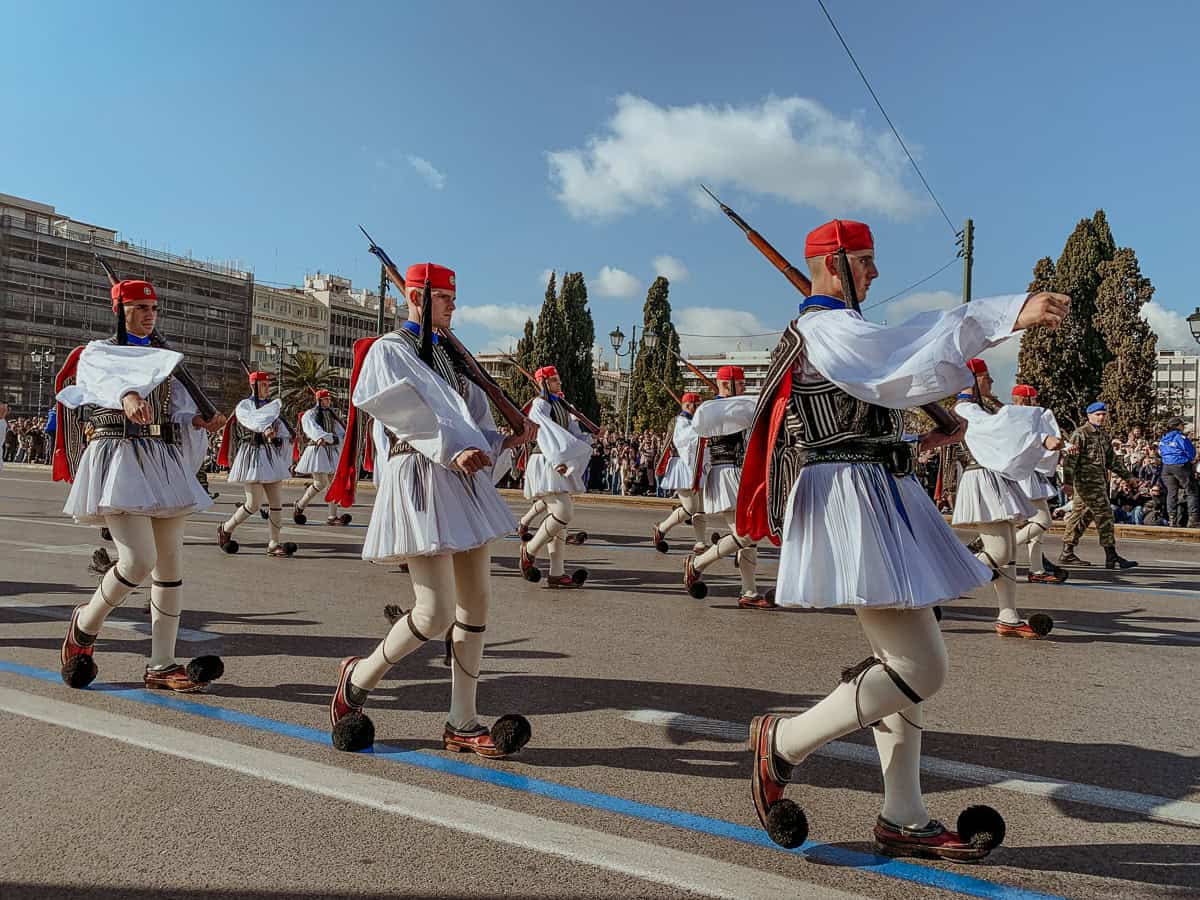
Who are the Evzones?
The Evzones are an elite unit of the Greek military known as the Presidential Guard. Their role is ceremonial, but it is taken extremely seriously and carries a great deal of honour within Greece.
The Evzones are responsible for guarding the Tomb of the Unknown Soldier in front of the Greek Parliament around the clock, in all weather conditions, and for performing the Changing of the Guard ceremony every hour.
They also guard the presidential mansion, so if you want to see them but avoid crowds at all costs, go there.
Selection for the Evzones is strict. Candidates must meet specific physical requirements, including a minimum height (1m90), and complete an intense training period that focuses on discipline, endurance, and absolute precision.
Standing motionless for long periods is a core part of their duty, as is the ability to perform slow, highly controlled movements while carrying heavy equipment. Knowing this helped me explain to my child why they couldn’t wave back or respond.
Tip 1: Understand Exactly How the Ceremony Works (Before You Go)
Before deciding when to go, it helps to understand what you’re actually going to see.
The guards are called the Evzones. They’re part of the Greek Presidential Guard, and although their role is ceremonial, it’s taken extremely seriously.
They guard the Tomb of the Unknown Soldier in front of the Greek Parliament around the clock, in all weather conditions. They also guard the Presidential Mansion.
Selection is strict. They have to meet specific physical requirements (including a minimum height of 1.90m) and go through intense training focused on discipline, endurance, and precision.
A big part of their duty is standing completely still for long periods of time.
Knowing this beforehand helped me explain to my child why they couldn’t wave back or respond. They’re not ignoring you — they’re not allowed to react.
Now:
There are two versions of the ceremony.
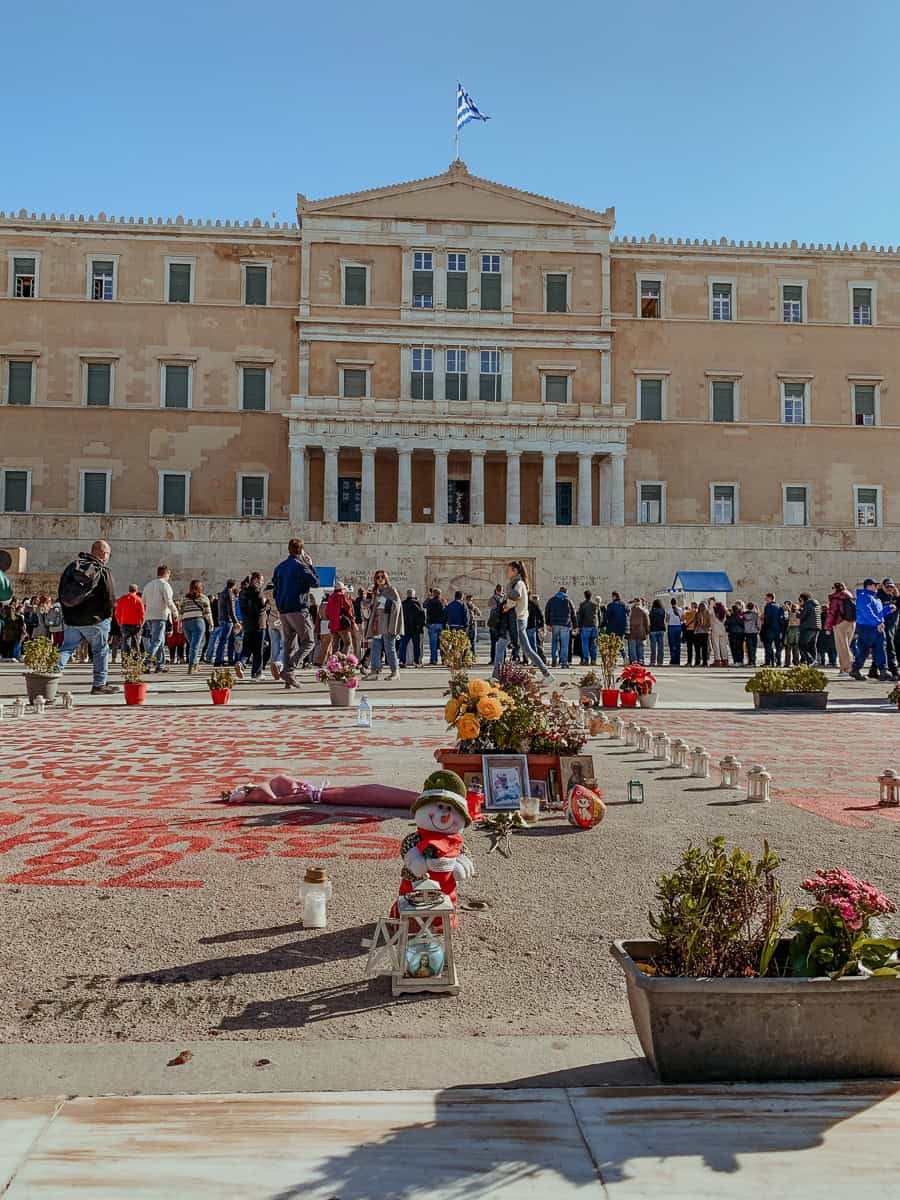
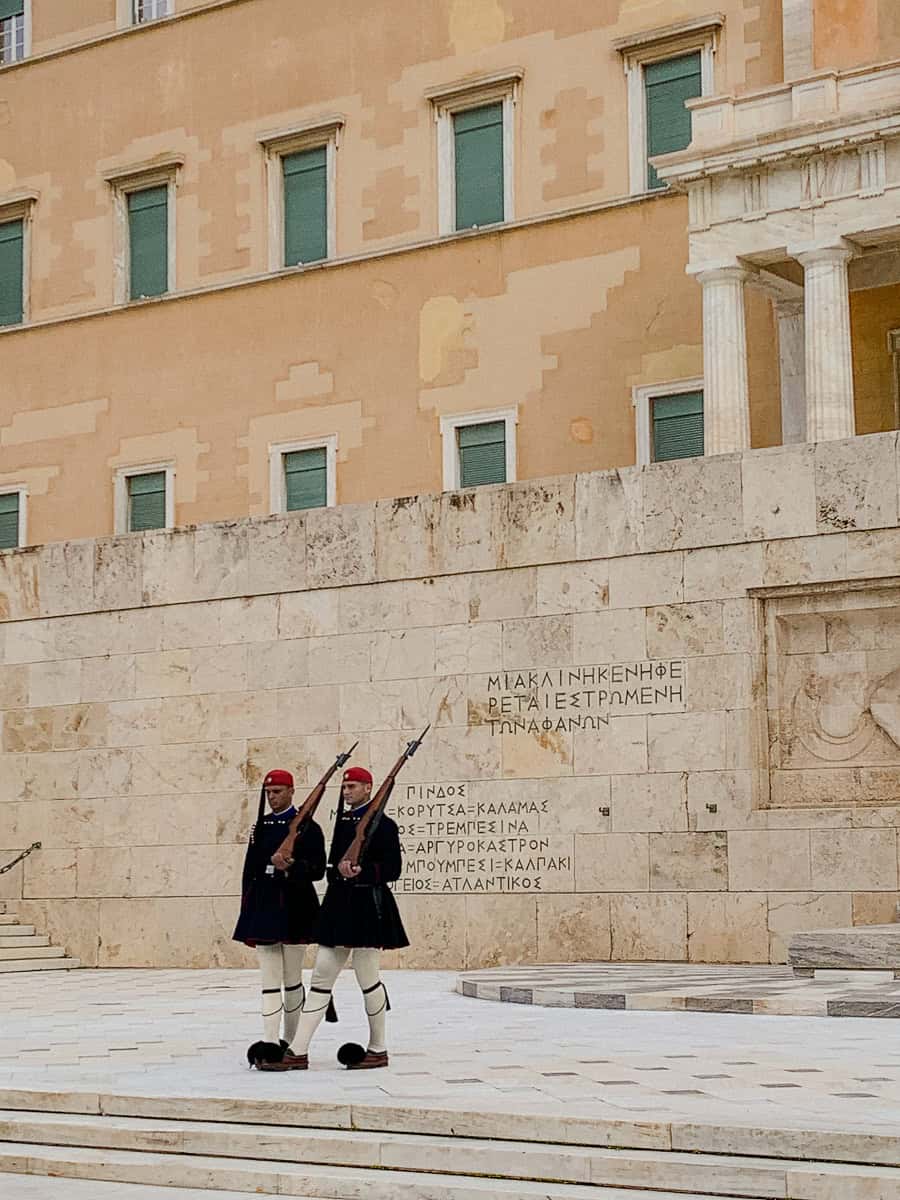
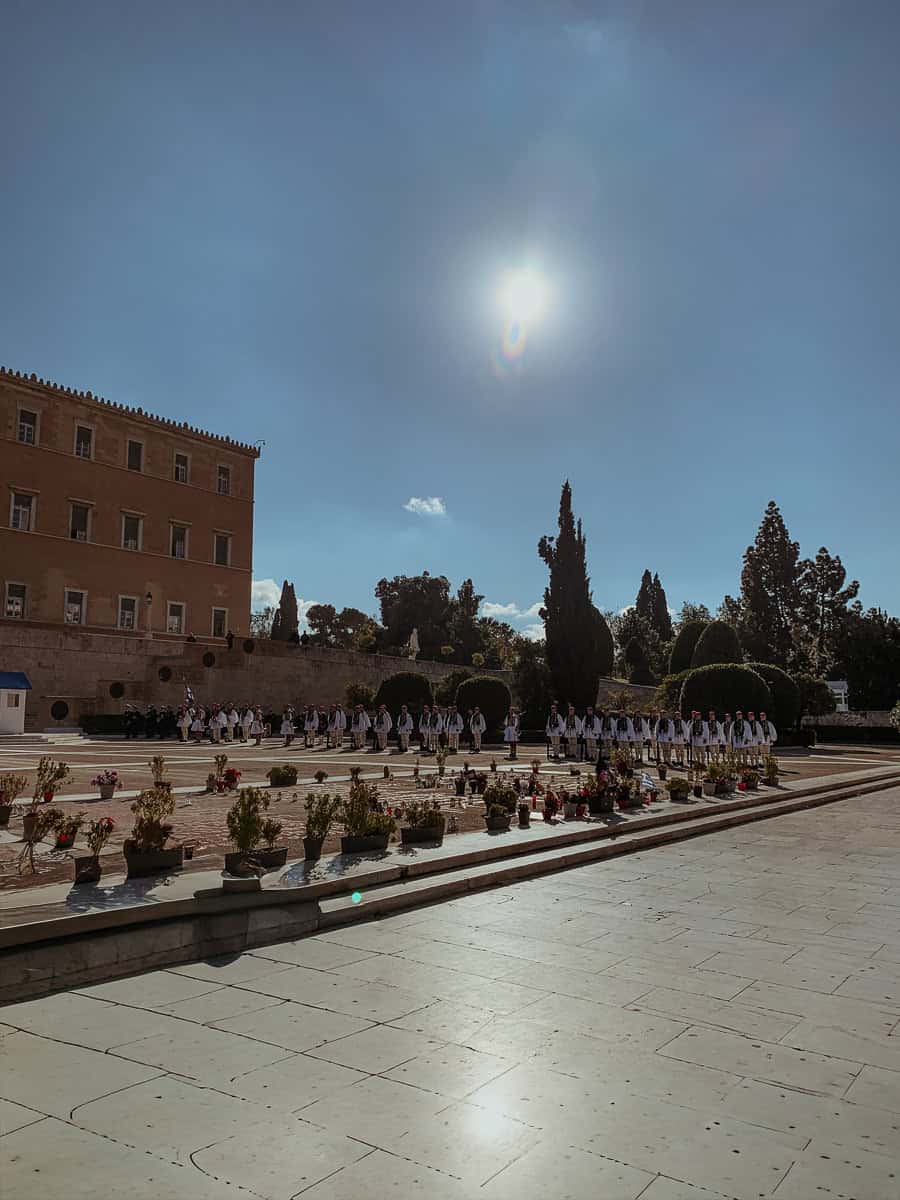
The hourly ceremony
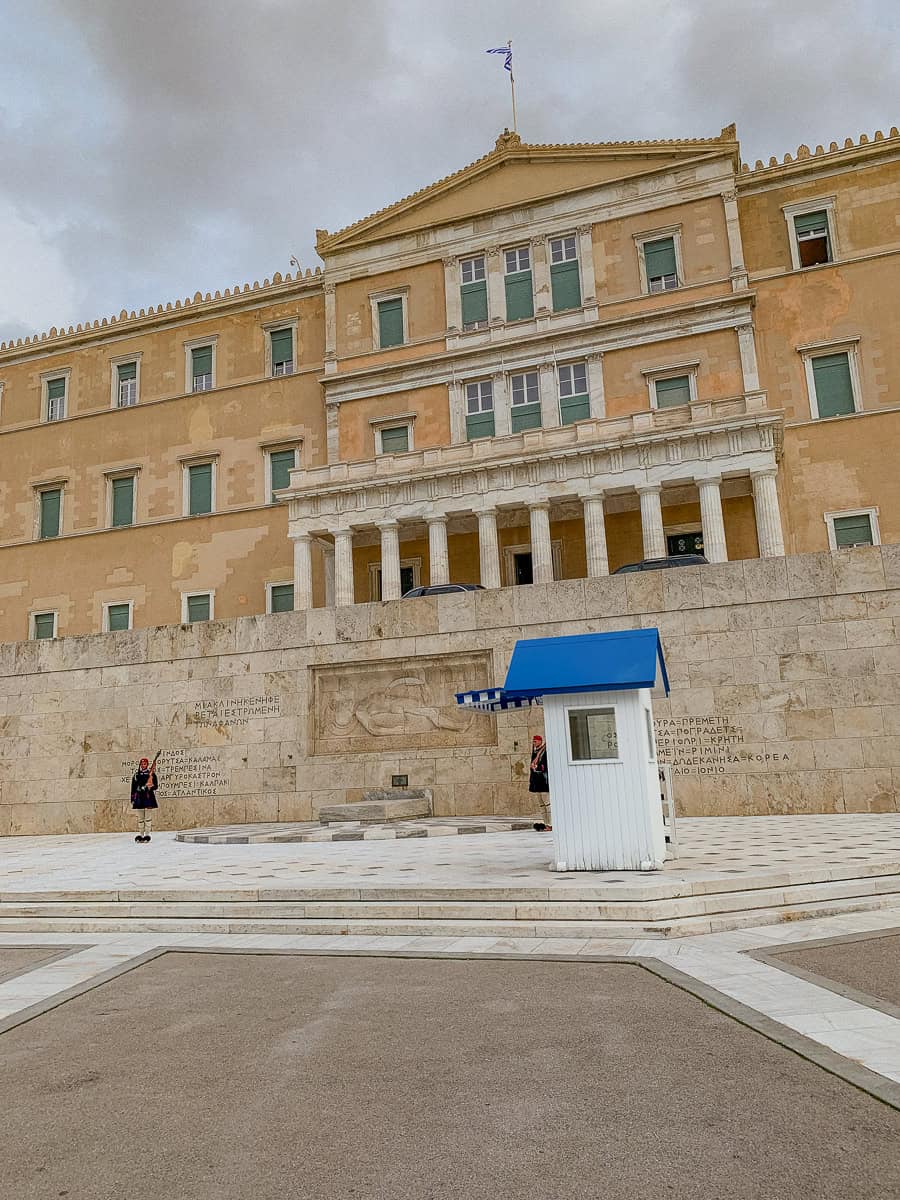
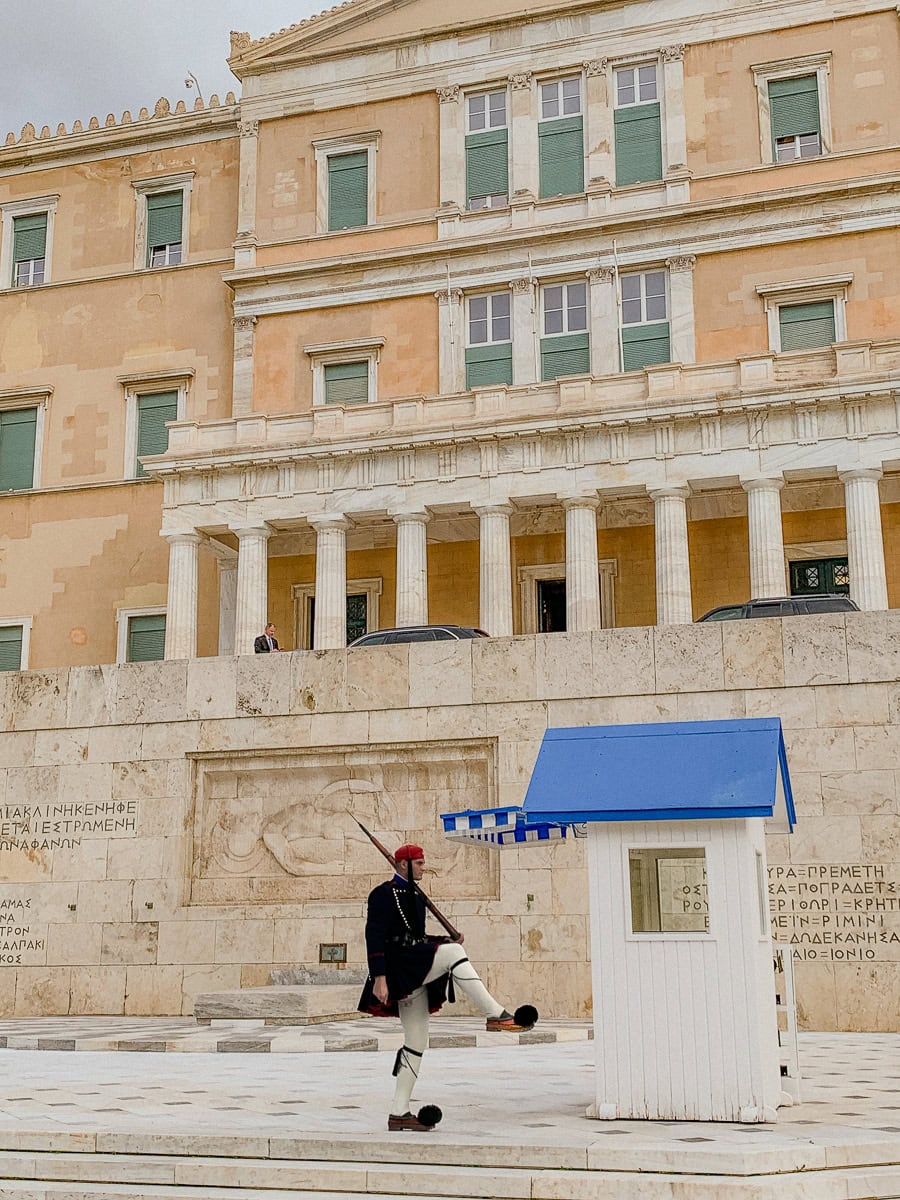
Every hour, on the hour, two new Evzones replace the two currently on duty at the Tomb of the Unknown Soldier.
This version of the ceremony is much smaller and lasts about 10 minutes. Four guards are involved in total — two finishing their shift and two taking over.
There’s no music. No band. No big build-up.
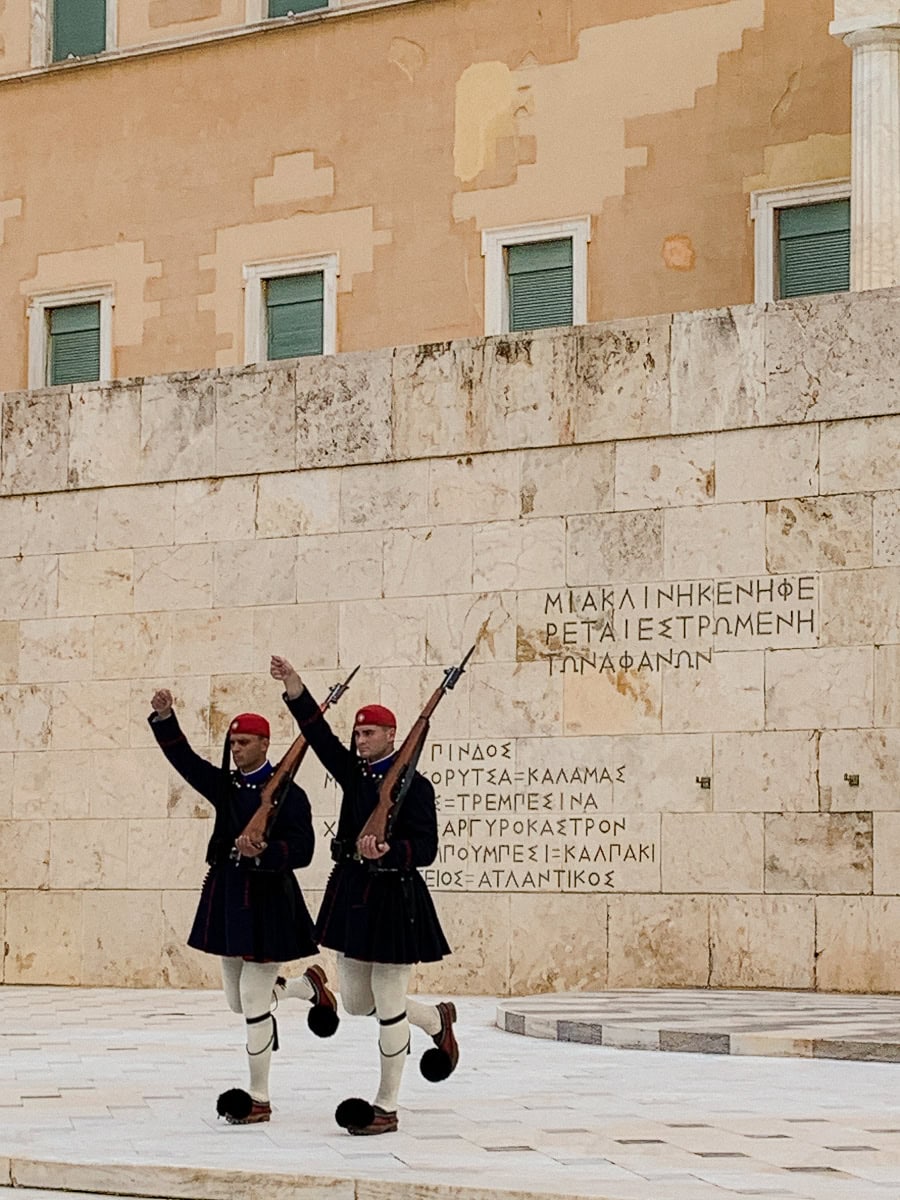
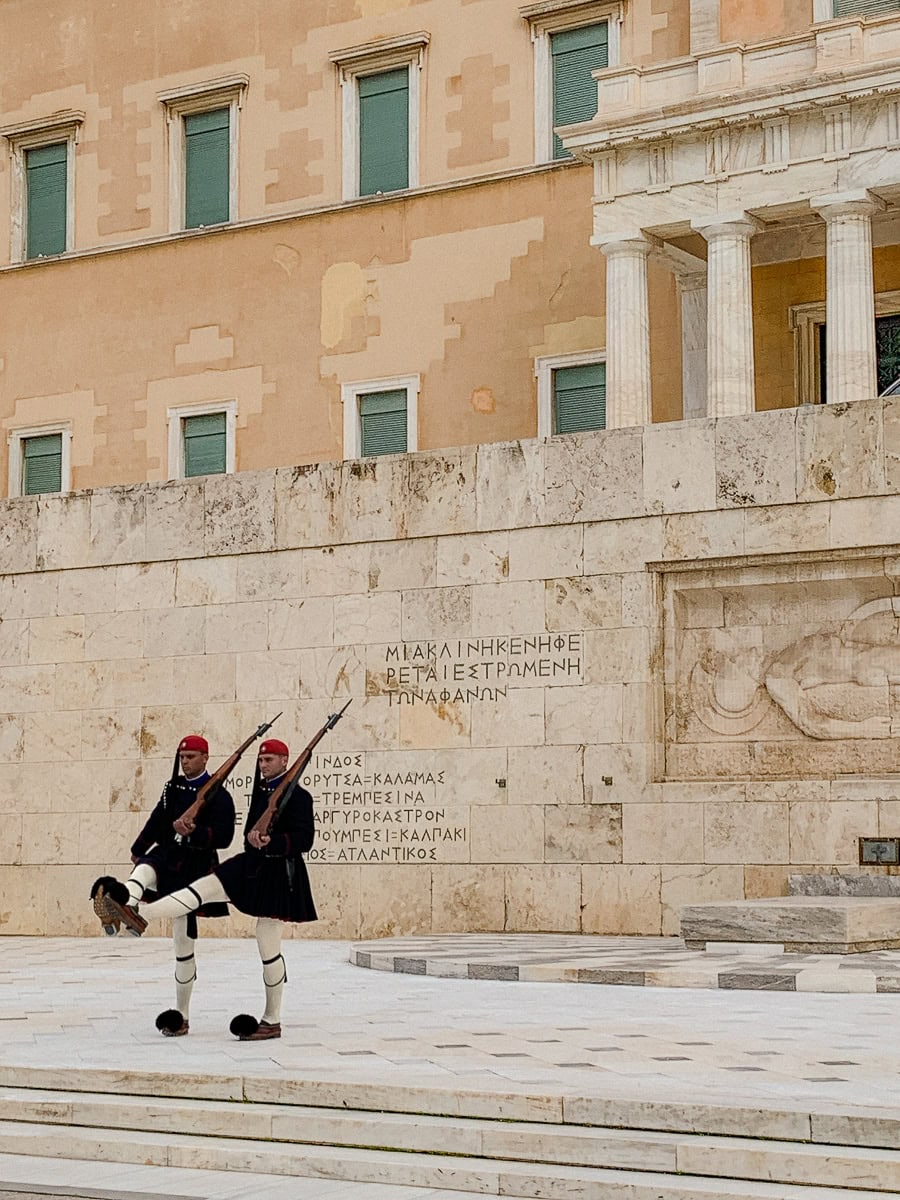
The main sounds you’ll hear are the heavy stomping of the tsarouchia shoes, a few short commands, and the constant background noise from the busy road right in front of Syntagma Square. It’s never completely quiet there.
The first time we visited, we arrived around 2:45 pm without checking the schedule. We ended up missing the exact moment of the change.
But here’s something that’s helpful to know:
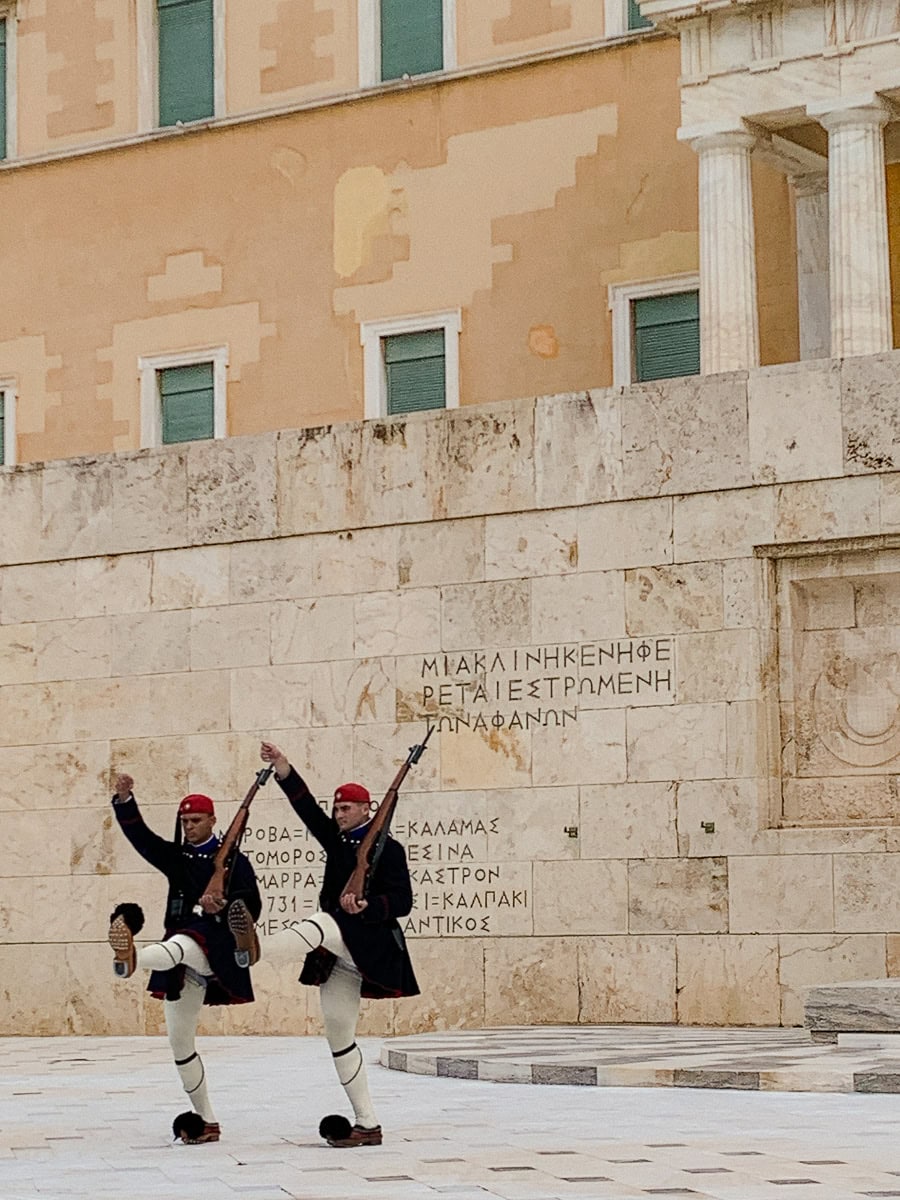
Even if you don’t catch the precise switch at the top of the hour, the guards don’t just stand frozen the entire time. During their shift, they periodically perform those slow, deliberate ceremonial movements — the high leg lifts and controlled steps.
So you still get to see the characteristic motions, even outside the official “change” moment.
That’s really useful if precise timing is tricky for your family. You don’t have to stress about arriving at exactly the right minute to see something meaningful.
The Sunday 11:00am Ceremony
Every Sunday at 11:00 am, there’s a much larger and more formal Changing of the Guard.
This is the version you’ll usually see in photos.
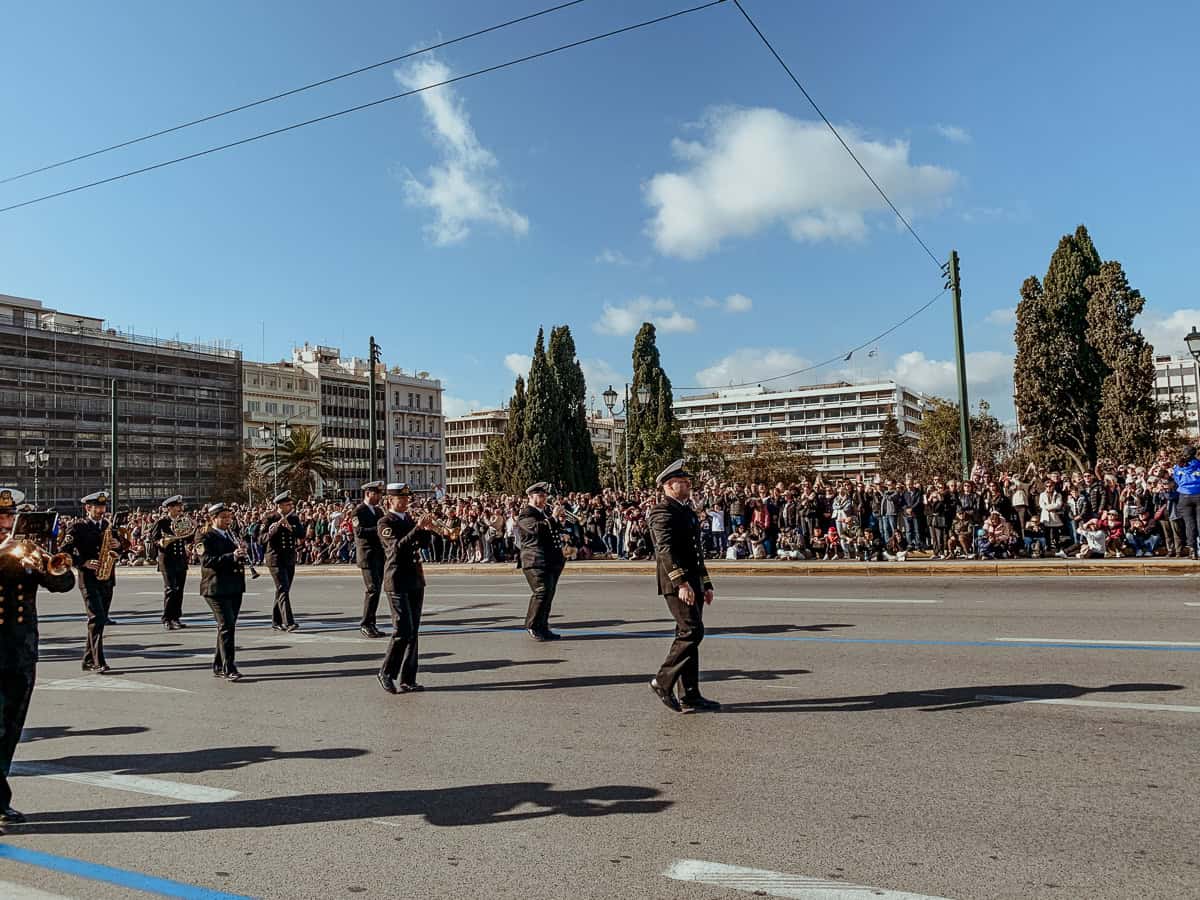
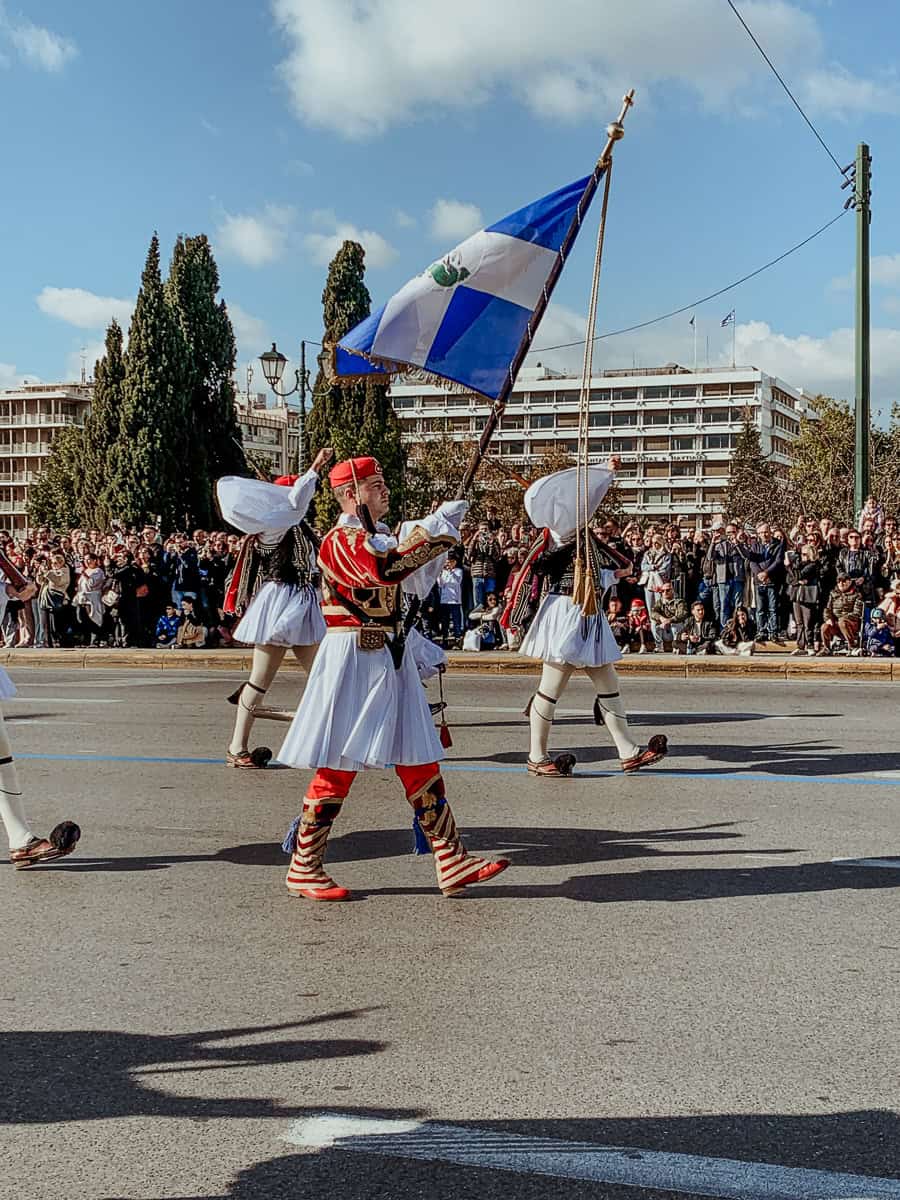
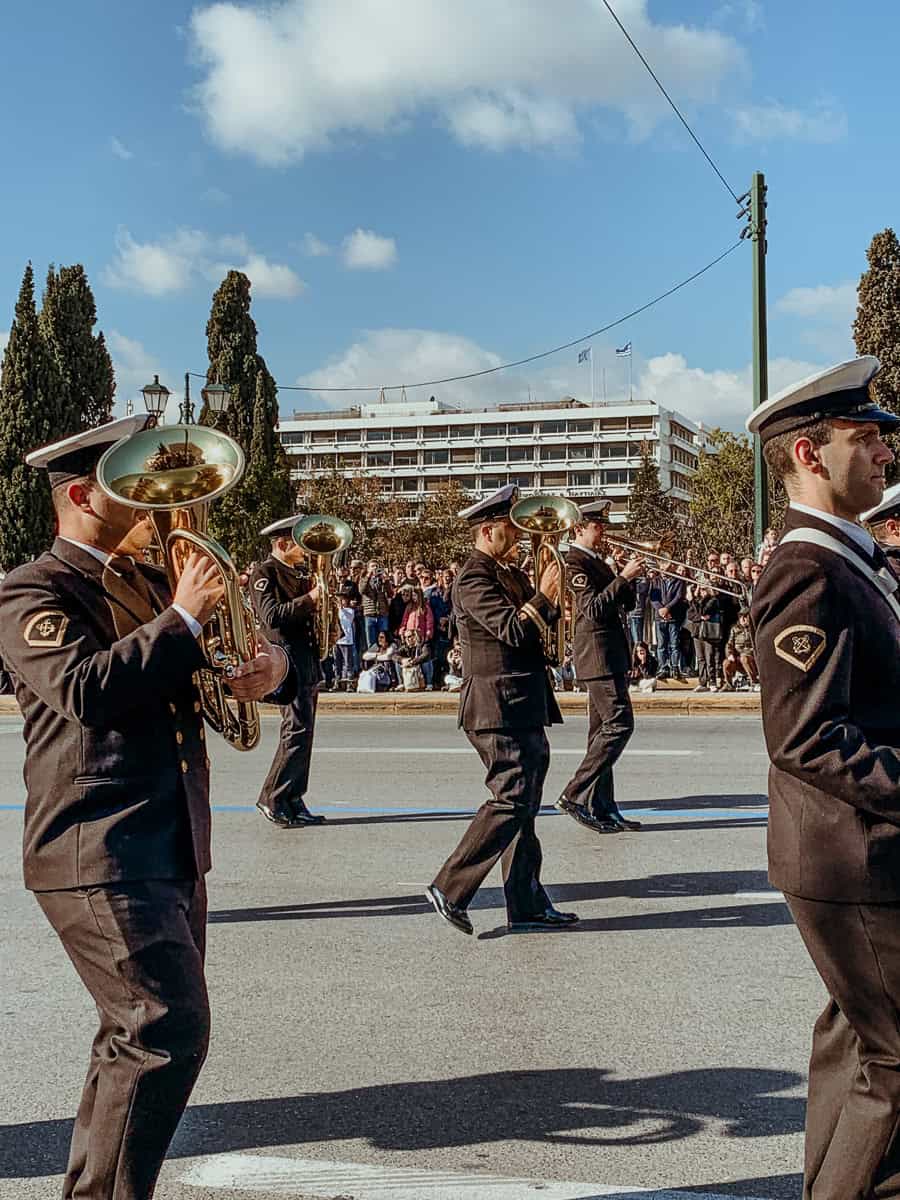
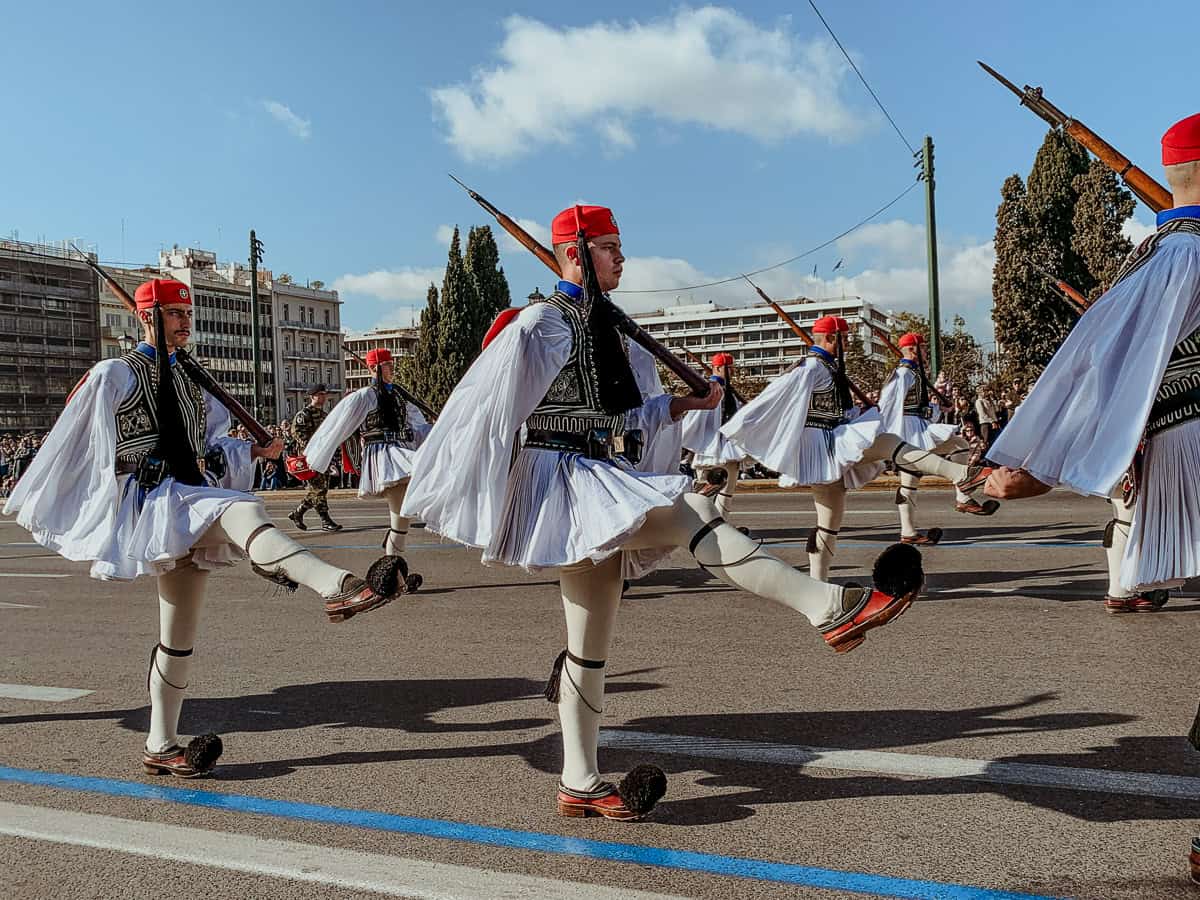
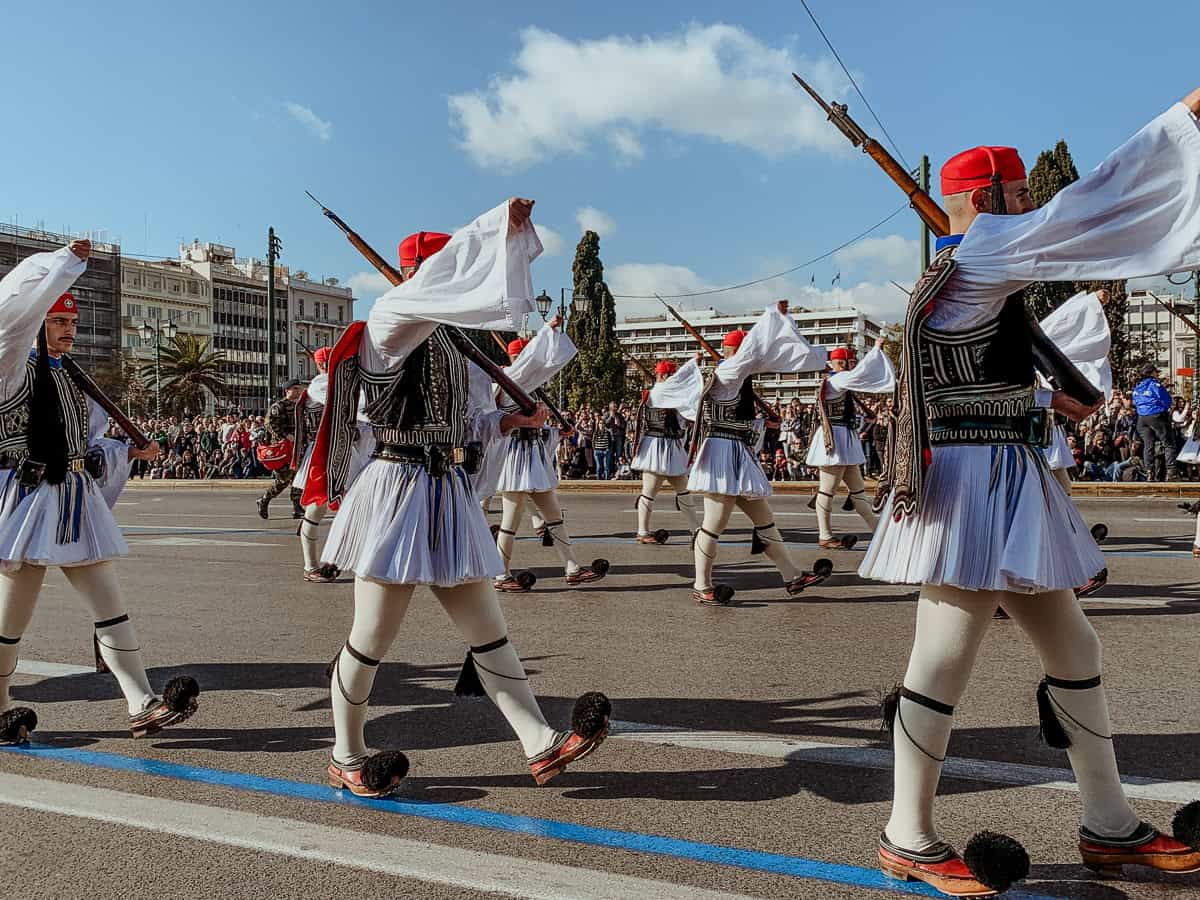
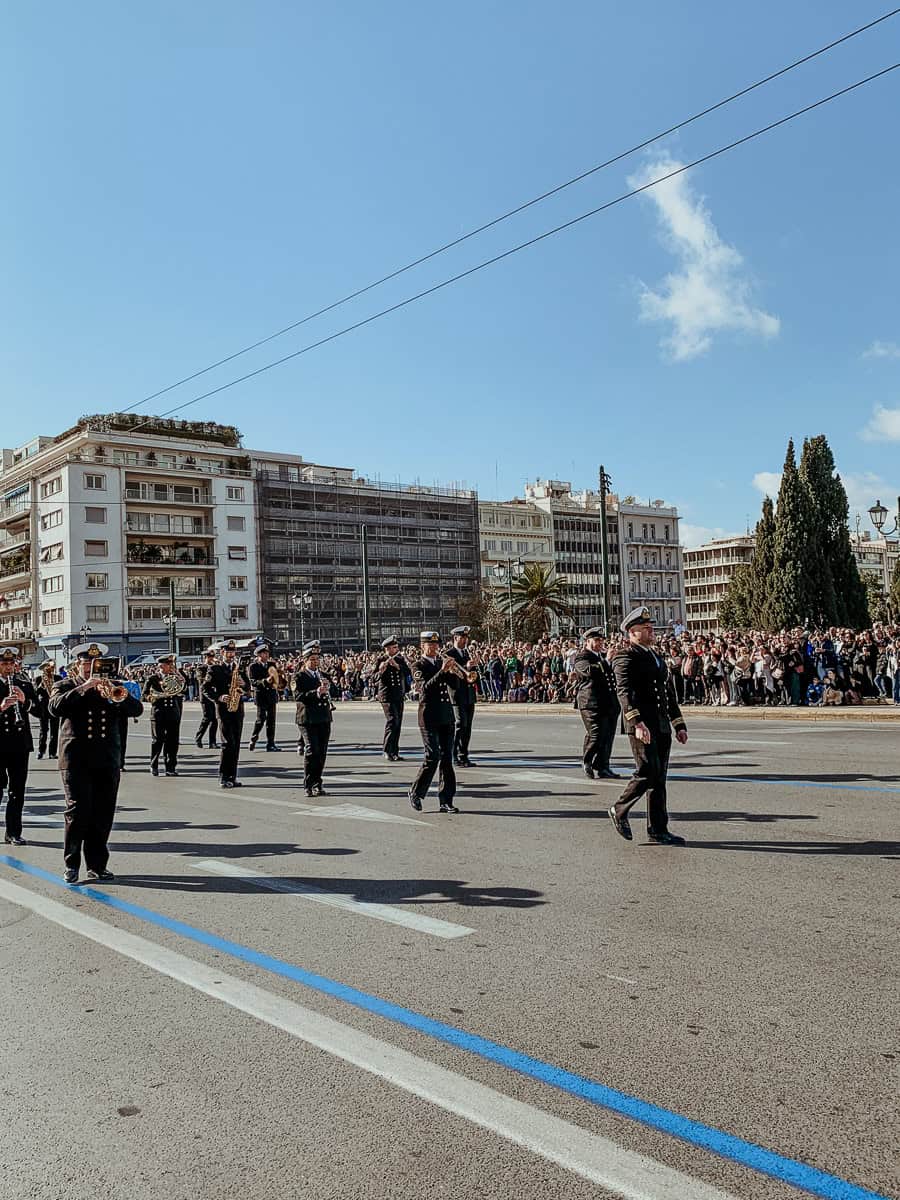
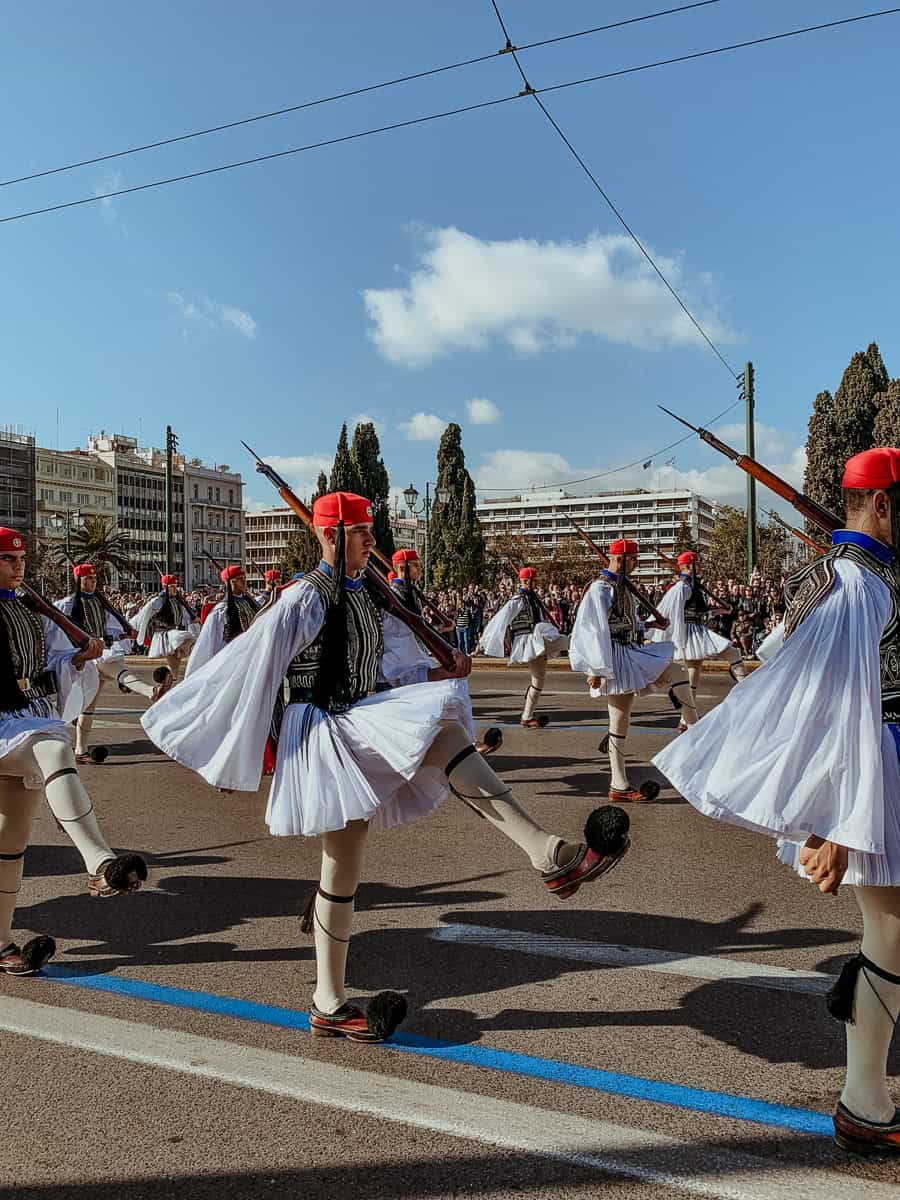
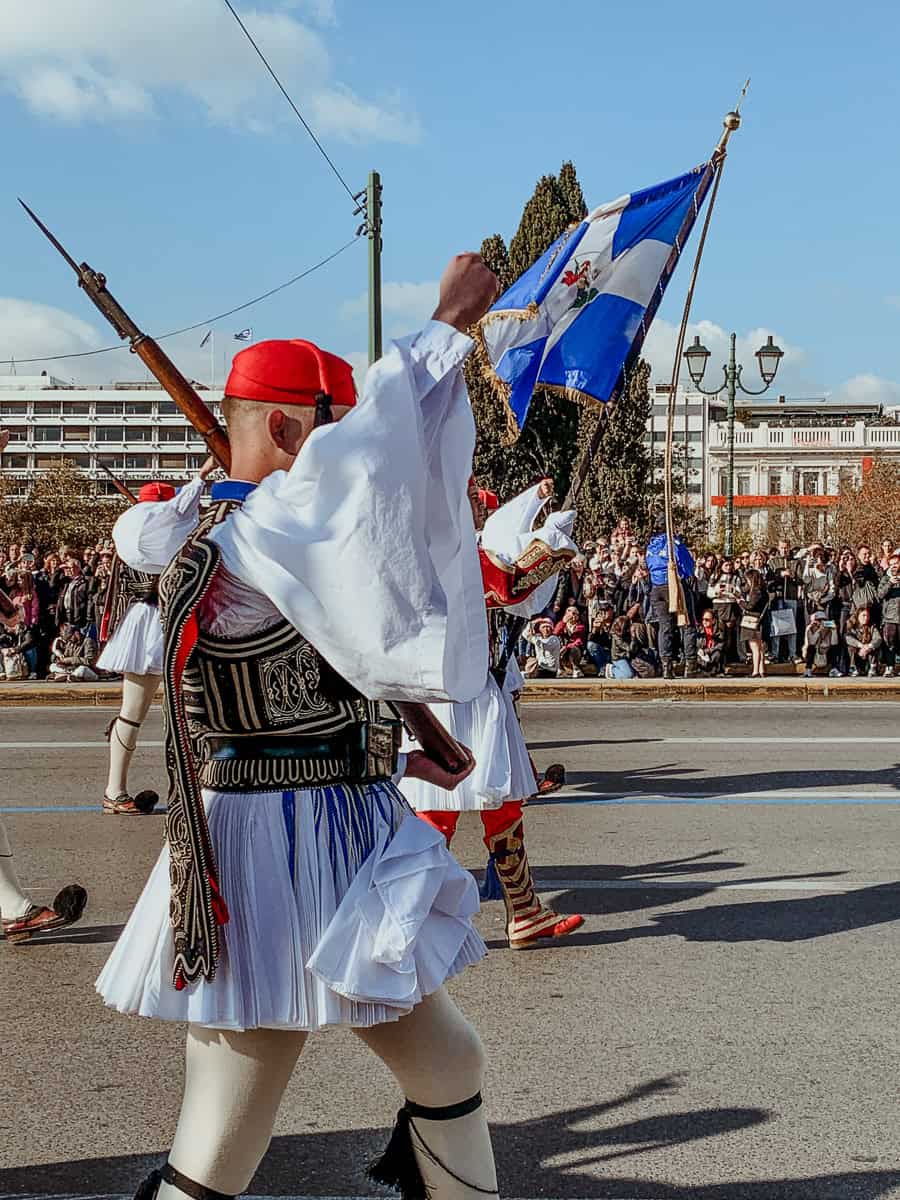
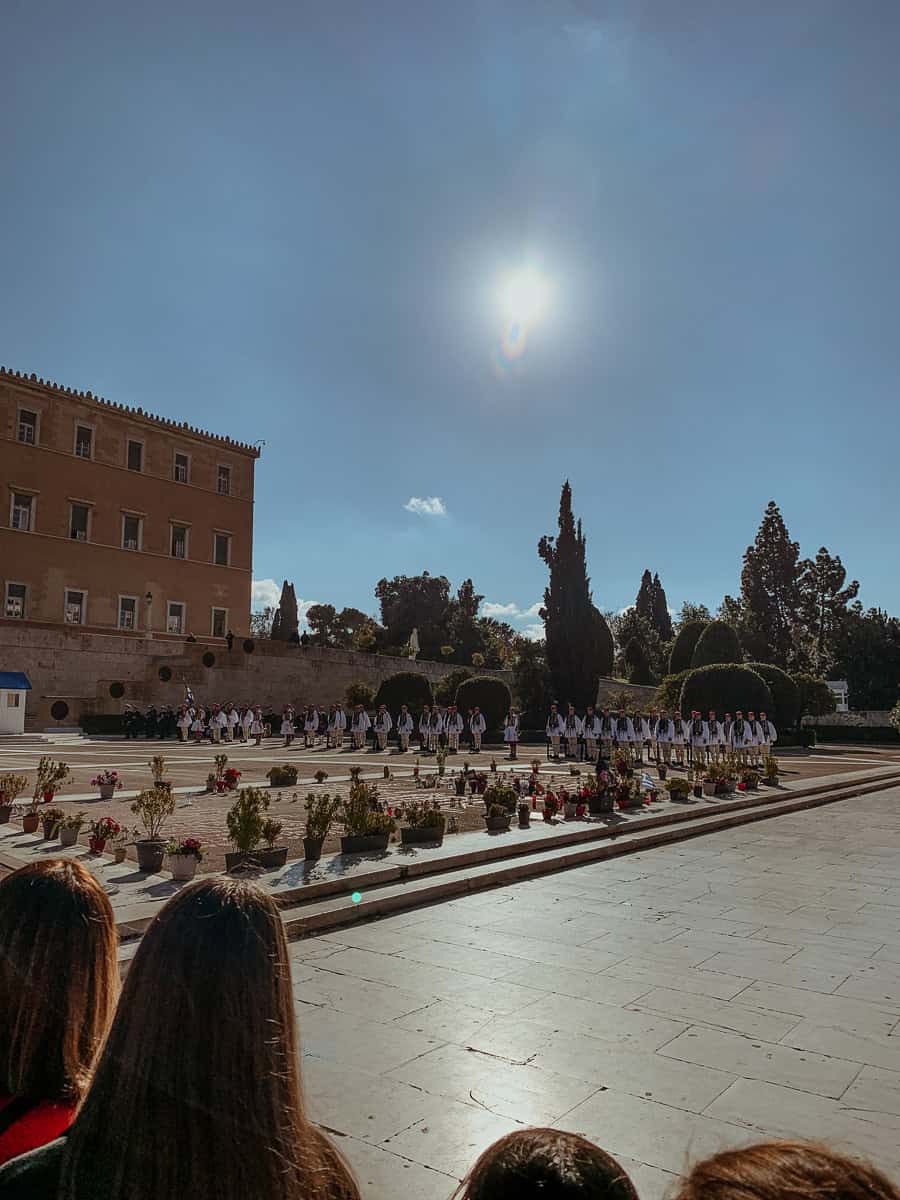
A full unit of Evzones marches in together, wearing the traditional white fustanella uniform. There’s a military brass band. Roads around Syntagma Square are closed. Police are present. And the square fills up quickly.
The ceremony itself runs roughly from 10:45 am to 11:15 am, even though the official change is at 11:00 am.
It’s visually impressive — the white uniforms, the coordinated marching, the music — and I’m genuinely glad we saw it.
But it’s also a very different sensory experience from the hourly change. There’s music, crowd movement, phones in the air, and a lot more intensity overall.
If your family does well with structure and spectacle, this can be special.
If crowds and unpredictability are hard, the hourly version might be a better fit.
The traditional outfit of the Evzones
The Evzones’ uniforms are one of the most iconic parts of the Changing of the Guard, and they vary depending on the day and occasion.
On Sundays at 11h and other official ceremonies, they wear the full formal uniform. This includes:
- The fustanella, a white pleated skirt made from about 30 metres of fabric with 400 pleats, which symbolises the 400 years of occupation by the Ottomans
- A white shirt with wide sleeves
- A hand-embroidered waistcoat
- A scarlet pharion cap with a long black tassel
- White woollen stockings
- The heavy leather tsarouchia shoes with distinctive black pom-poms.
These formal uniforms are handmade by specialised craftsmen and can take many months to complete.
On regular days outside of major ceremonies, the Evzones still wear traditional elements, including the pharion, tsarouchia, and stockings, but their everyday uniform uses a more practical tunic called a doulamas: khaki in summer and navy wool in winter.
This helps them perform their hourly duties while still maintaining their recognisable ceremonial presence.
Tip 2: Expect Crowd Flow to Change Throughout the Sunday Ceremony
This is where it gets interesting.
I had planned a stop at the playground in the National Garden first. Let him move his body before he needed to stand still for a while.
By the time we made it to Syntagma Square around 10:35 am (after a meltdown because my youngest really didn’t want to leave the playground), parts of the square were already blocked off by police.
We ended up crossing the street a couple of times and entering from the opposite side to figure out where we could still stand.
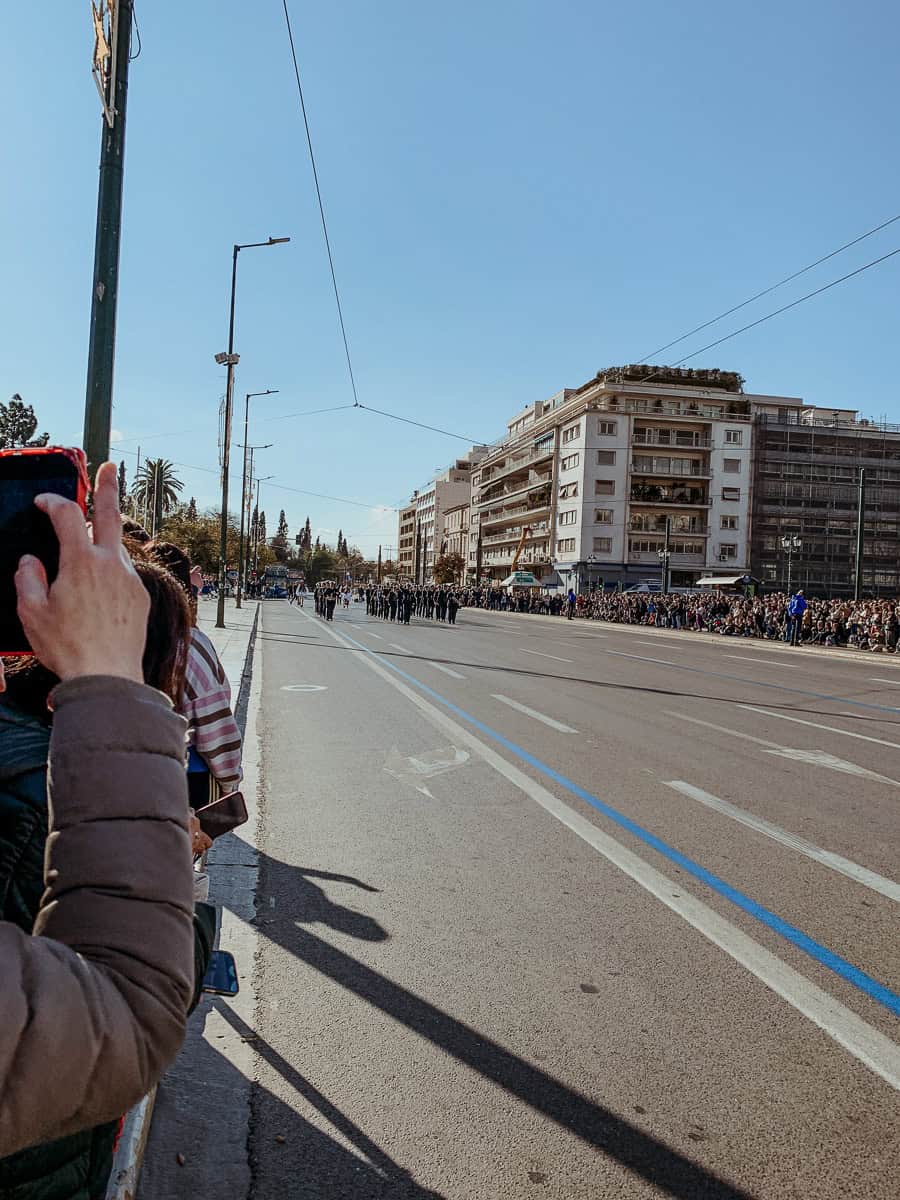
Not long after, the road in front of Parliament was completely closed to traffic. And honestly, that part was a relief. The constant city noise from the busy street suddenly disappeared, which made everything feel a bit more contained.
You hear the brass band before you see anyone.
That steady, rhythmic marching sound builds slowly as they approach. For my youngest, who loves brass music, that was actually a big win. It shifted the mood instantly.
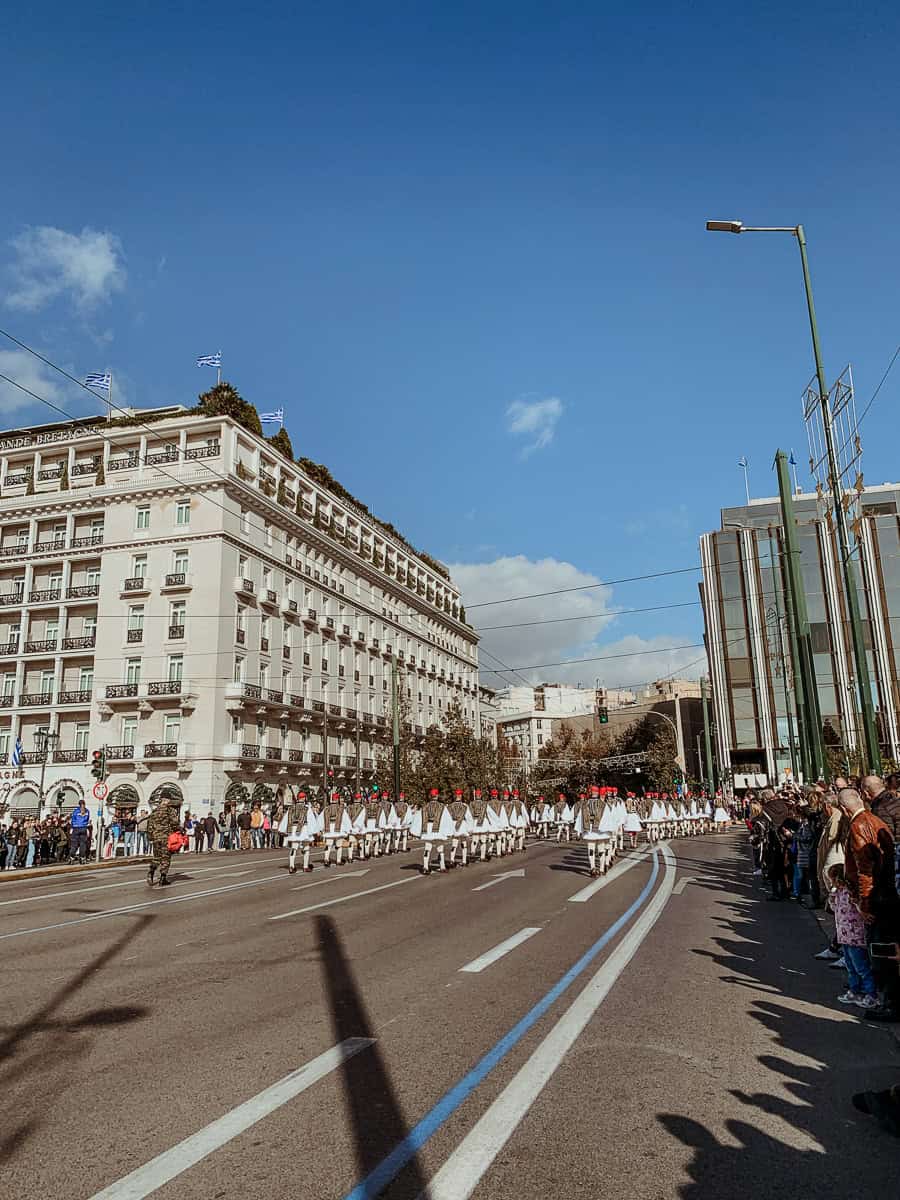
And then the Evzones came into view, marching in with their slow, highly controlled steps.
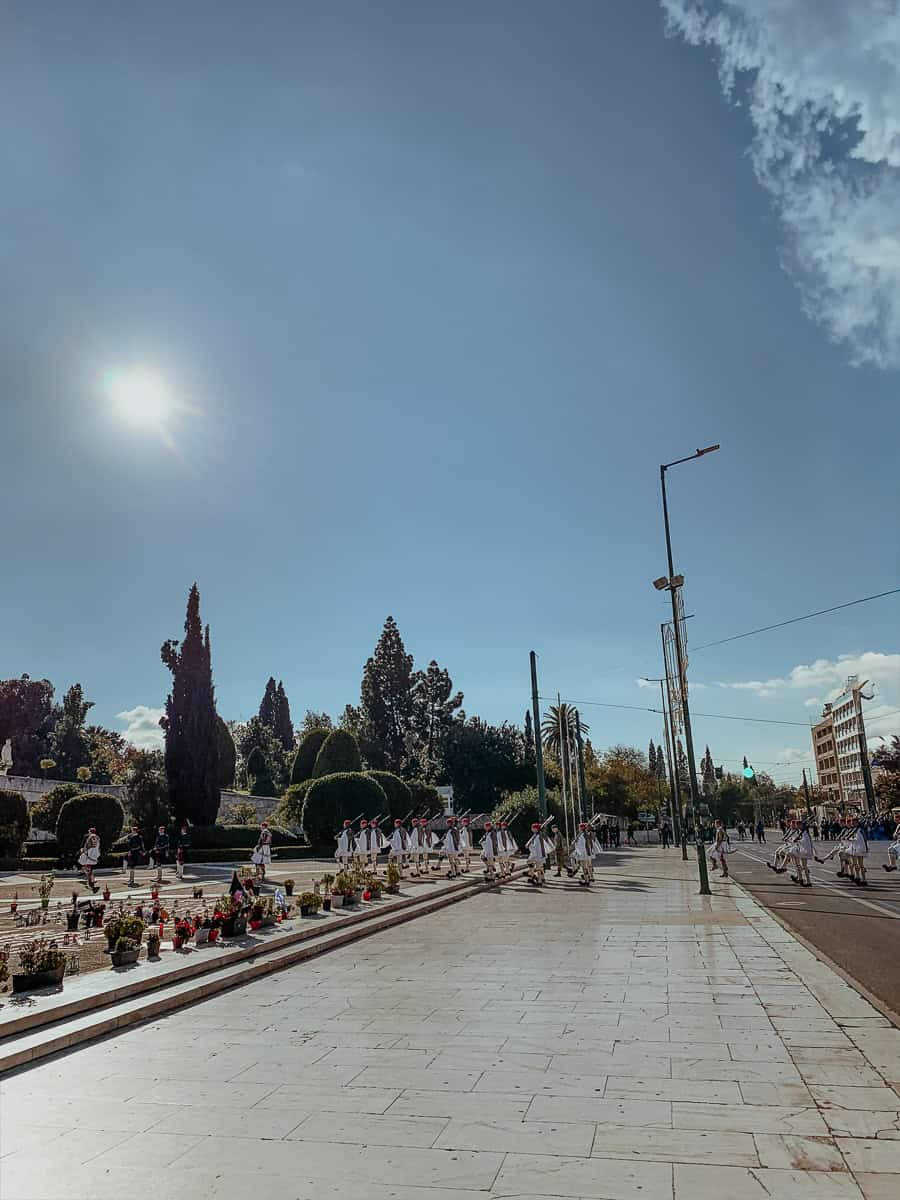
They performed the main ceremony in front of the Tomb of the Unknown Soldier and then marched back the same way they had come.
Now here’s the part I wasn’t prepared for:
The whole ceremony lasts about 30 minutes (from 10.45h to 11.15h), but the first five to ten minutes were the hardest.
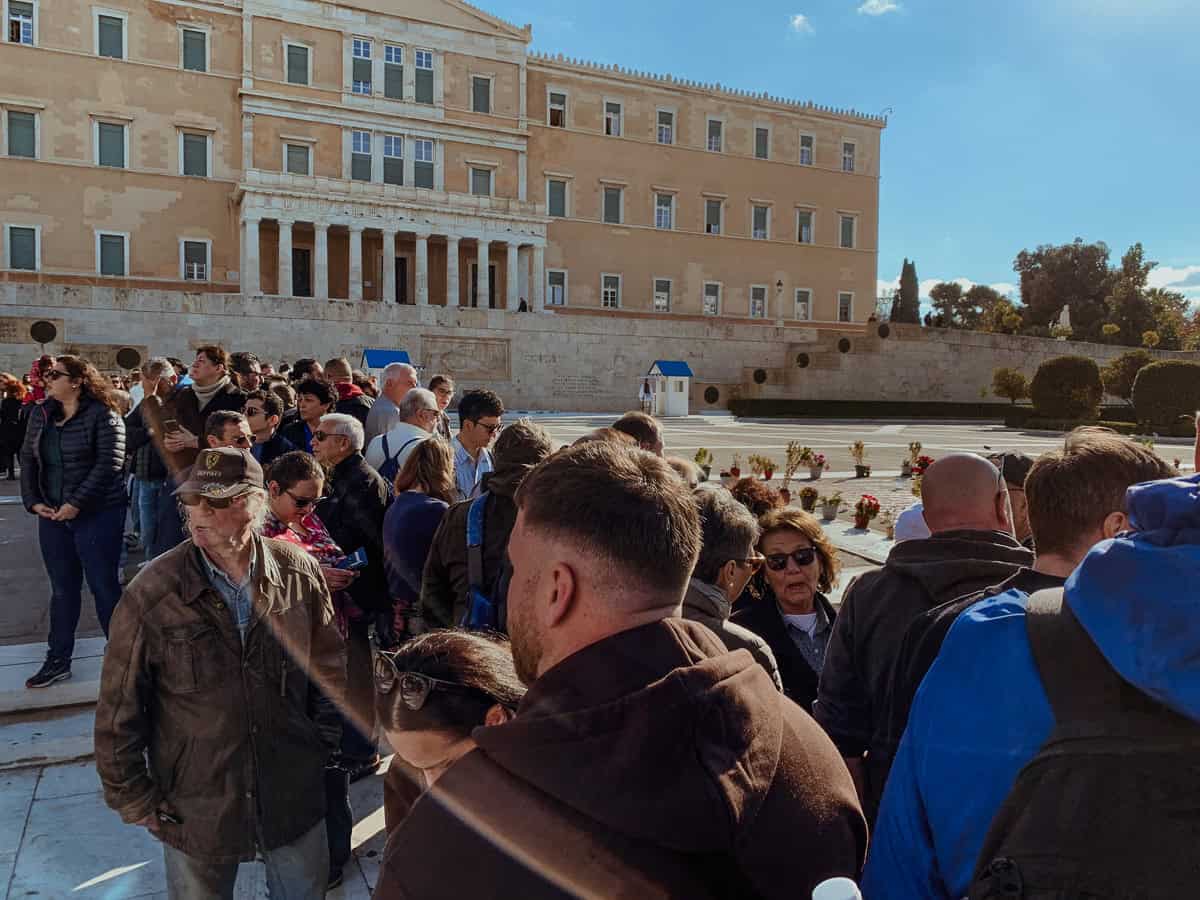
People were pushing forward.
Phones were held high.
It was difficult to see anything without straining.
My youngest started signalling that it was getting too much, so we stepped back, sat down on the steps, had something to eat, and waited.
That turned out to be the best decision.
As people began to leave, the space opened up, and we were able to move into a front-row spot near the street just before the guards marched away.
They passed right in front of us, and we got a clear view of them, which ended up being the highlight of the experience.
If you don’t get a good spot at the beginning, waiting and catching the marching out can be a much better and much less overwhelming experience – it was for us!
Tip 3: Choose Your Viewing Spot Strategically
It can be a bit of a pickle to figure out where to stand during the Sunday ceremony.
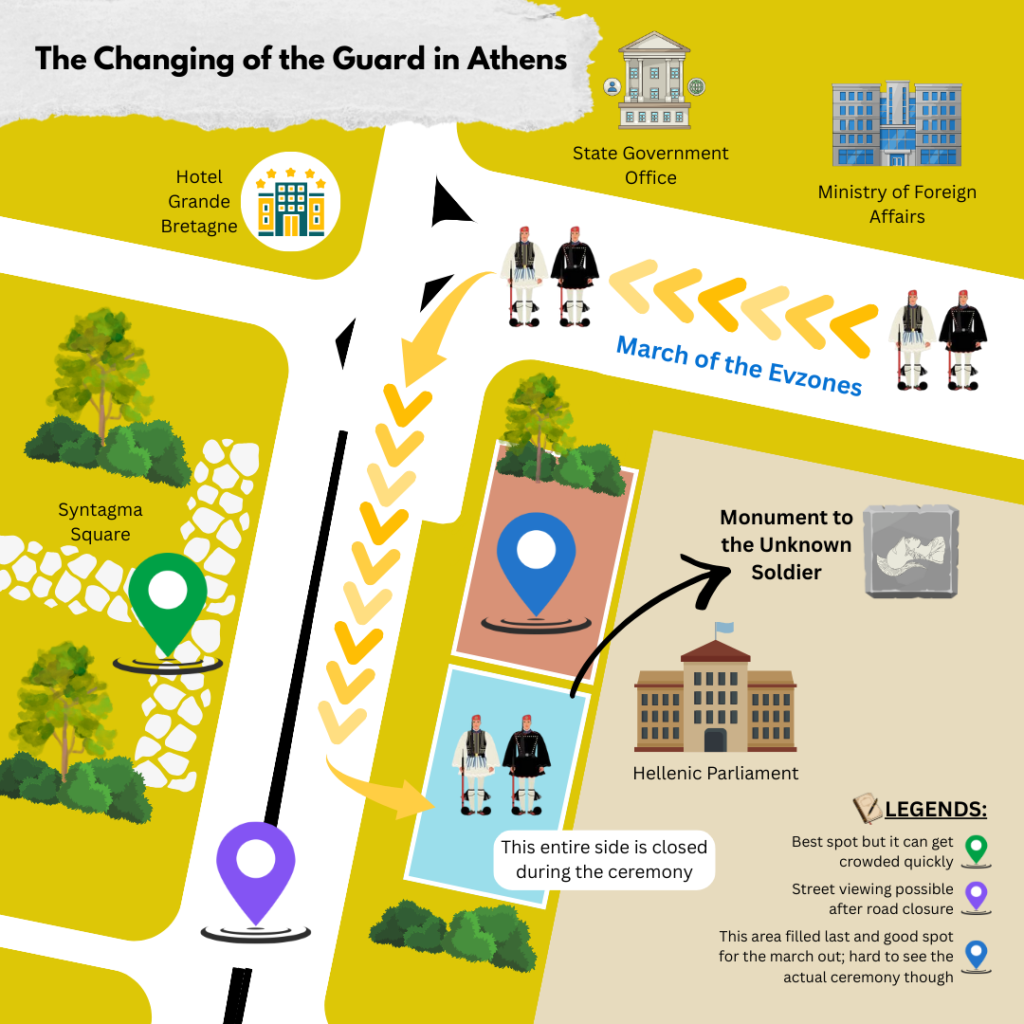
If you happen to be staying at the Grande Bretagne Hotel with a balcony overlooking Syntagma Square, you’re in luck. That’s probably the calmest and easiest view you’re going to get.
But assuming you’re not…
If I were to watch the Sunday Changing of the Guard again, I would come around 10:00am and stand across the street, roughly in the middle.
From there, you can see the marching very clearly, and you still get a good view of the ceremony in front of the Tomb of the Unknown Soldier. You won’t be super close to the monument itself, but that actually helps. The crowd tends to press forward there, and it can feel tight.
Across the street, there’s more breathing room. Kids can sit down on the sidewalk if they need to, which makes a big difference if you’re waiting.
For the regular hourly change, it’s much easier. There’s more space to move around and you don’t have to commit to one exact viewing spot.
And if crowds are really not your thing?
You can also see the Evzones guarding the Presidential Mansion. It’s much quieter and feels far less touristy — a completely different atmosphere.
Tip 4: Prepare for Sensory Load (Especially With Neurodivergent Kids)
Let’s be honest about this.
Syntagma Square is not a quiet place. It’s right in the centre of Athens, there’s a big road in front of the Parliament, and there’s almost always traffic. Even during the regular hourly ceremony, you’ll hear cars, buses, and general city noise in the background.
On Sunday at 11:00, you can add a few extra layers.
There’s the brass band.
Police whistles.
Road closures.
People pressing forward.
Phones held high in the air.
And quite a bit of standing around.
For us, standing still was actually the hardest part. Especially when you arrive early and then have to wait.
A little bit of preparation goes a long way here.
Headphones can really help if your child is sensitive to sudden or layered noise. Sunglasses can take the edge off visually. Snacks and fidgets make waiting much more manageable. And maybe most importantly: decide in advance where you can step away if it gets too much.
For my youngest, simply being able to sit down on the steps and eat something before going back into the crowd made all the difference.
Try to follow your child’s signals early. If you sense it’s building, step back before it tips over. You can always rejoin later.
And honestly, that flexibility is what made this experience work for us.
Tip 5: It’s Okay to Skip It (Or Choose the Calmer Version)
Well, obviously, I won’t be telling you what to do. But know that it’s okay to skip it: If crowds or noise are a hard no, choosing another activity is the right call.
Plan a trip to the National Garden for a more silent moment in nature. While you make your way to the park, you’ll pass the Evzones, so you’ll still be able to see them (although very briefly).
Alternatively, stop by the Evzones at another time of the day. You might get lucky and catch them during a moment when they’re moving around. Or, go to the Presidential Mansion, as that’s off the tourist path.
However, if you and/or the kids don’t mind the crowds, I think it’s a really fun, free thing to do in Athens that gives you insights in the traditional Greek culture.
I’m really glad my youngest and I went to see the Change of the Guard, but I’m also glad Kath and my oldest didn’t join because they would’ve been impacted by the crowd a lot more.
How to get to Syntagma Square
Syntagma Square is the heart of Athens and one of the easiest places in the city to reach.
The simplest option is the metro: Syntagma station is served by Line 2 (red) and Line 3 (blue), and when you exit the station, you are already on the square.
From there, it’s just a short walk across the (busy) road to the Greek Parliament and the Tomb of the Unknown Soldier.
Many buses and trams also stop nearby, and if you’re staying in central Athens, it’s often walkable from areas like Plaka, Monastiraki, or Kolonaki.
Because it’s such a busy transport hub, expect crowds at most times of day, which is useful to know if you’re arriving with children or anyone who needs a bit more time and space to navigate.