
Lake Vouliagmeni With Kids: Neurodivergent-Friendly Tips
There’s a good chance this post contains affiliate links. This means that if you purchase anything through one of our links, we’ll receive a small fee (it won’t cost you anything, promise!). As an Amazon Affiliate, we earn from qualifying purchases. If you would like to learn more about our affiliate partners, click here for our disclaimer.
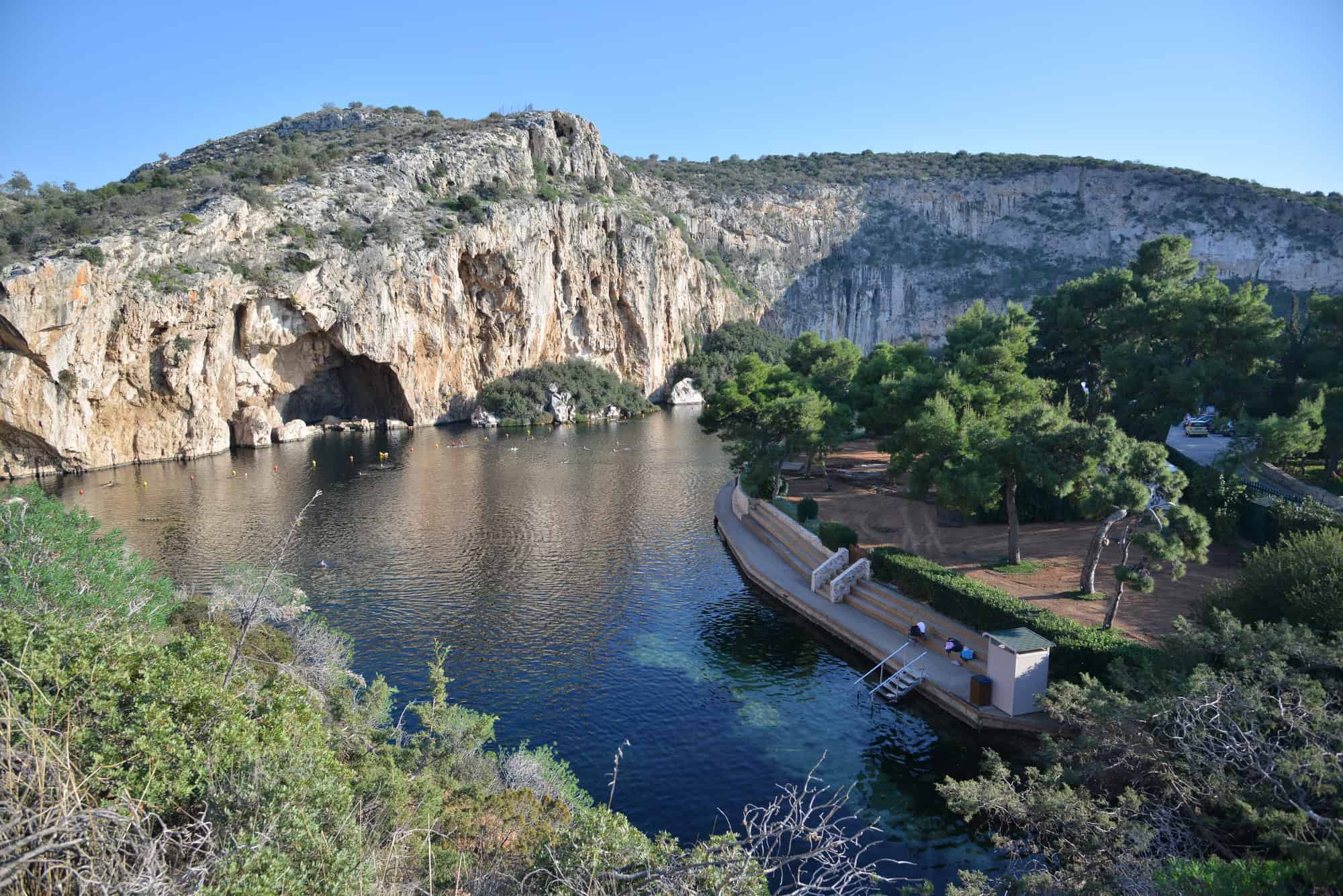
Lake Vouliagmeni is a natural thermal lake just outside Athens, along the Athens Riviera.
It’s often recommended as an easy day trip because the water stays warm year-round, the setting is beautiful, and it feels like a calm break from the city without having to go far. On paper, it sounds like the perfect slow day.
In reality, the experience can vary a lot. The time of day, the season, how busy it is, and whether you visit on your own or with a tour all make a big difference. What feels peaceful and restorative at one moment can feel crowded, noisy, or overwhelming at another.
In this article, I’ll share what visiting Lake Vouliagmeni is really like with kids. I’ll focus on sensory details, practical logistics, and small choices that can make the visit easier or harder.
This is written for neurodivergent families, families with kids, and anyone who needs predictability, rest, and low-pressure plans more than a packed sightseeing schedule.
Lake Vouliagmeni at a glance
📍 Where: Vouliagmeni (on the Athens Riviera), about 24 km from Athens
⌚ Time: 2 – 5 hours
🚍 How: By public transport, rental car, hop-on-hop-off bus or guided tour
🏛️ Tour recommendation: This small-group tour brings you to all the Athens Riviera highlights: Lake Vouliagmeni, Kape Beach, and the Temple of Poseidon! If you prefer to go with just your family, pick this private full-day tour to the Lake and the Temple of Poseidon.
What is Lake Vouliagmeni (and why is it special)?
Lake Vouliagmeni is a natural thermal lake just outside Athens, fed by underground springs and connected to the sea. The water is brackish (a mix of fresh and salt water) and stays warm year-round, between 21 and 29°C, depending on the season.
People come here to swim, relax, and unwind in what’s often described as “healing” water, without needing to leave the Athens area. It feels like a nature break, but it’s very easy to reach.
That said, this isn’t a wild or untouched lake. It’s a managed site with controlled entry, facilities, staff, and clear rules. It feels posh and gets expensive quickly.
A bit of history & science
Lake Vouliagmeni was formed by a collapsed cave system, and it’s still connected to a network of underwater tunnels that run deep below the area. This is also why the lake is linked to both underground springs and the sea.
The water stays warm because it’s constantly fed by geothermal springs, which keep the temperature fairly stable all year, even in winter. Don’t expect the water to feel hot, though!
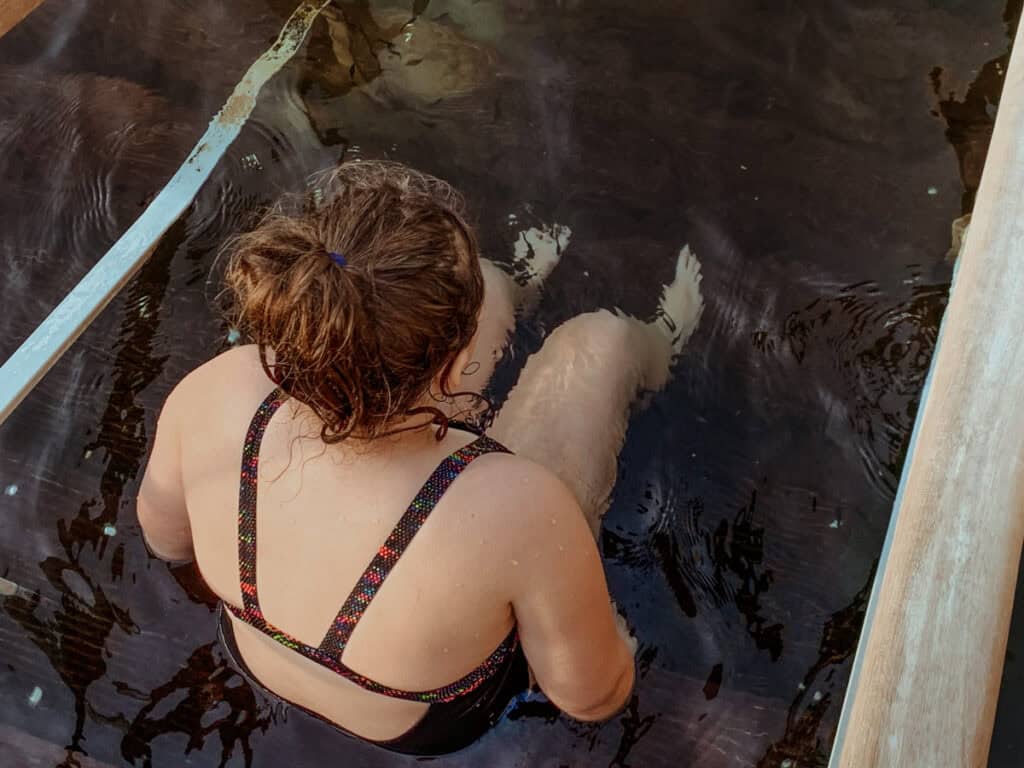
You’ll also notice small fish in the lake. They’re harmless, but they often swim close to people and will nibble at your feet and legs, mostly near the edges. For some kids, this is fun and fascinating; for others, it can be a strong sensory experience, so it’s good to know in advance.
Where is Lake Vouliagmeni?
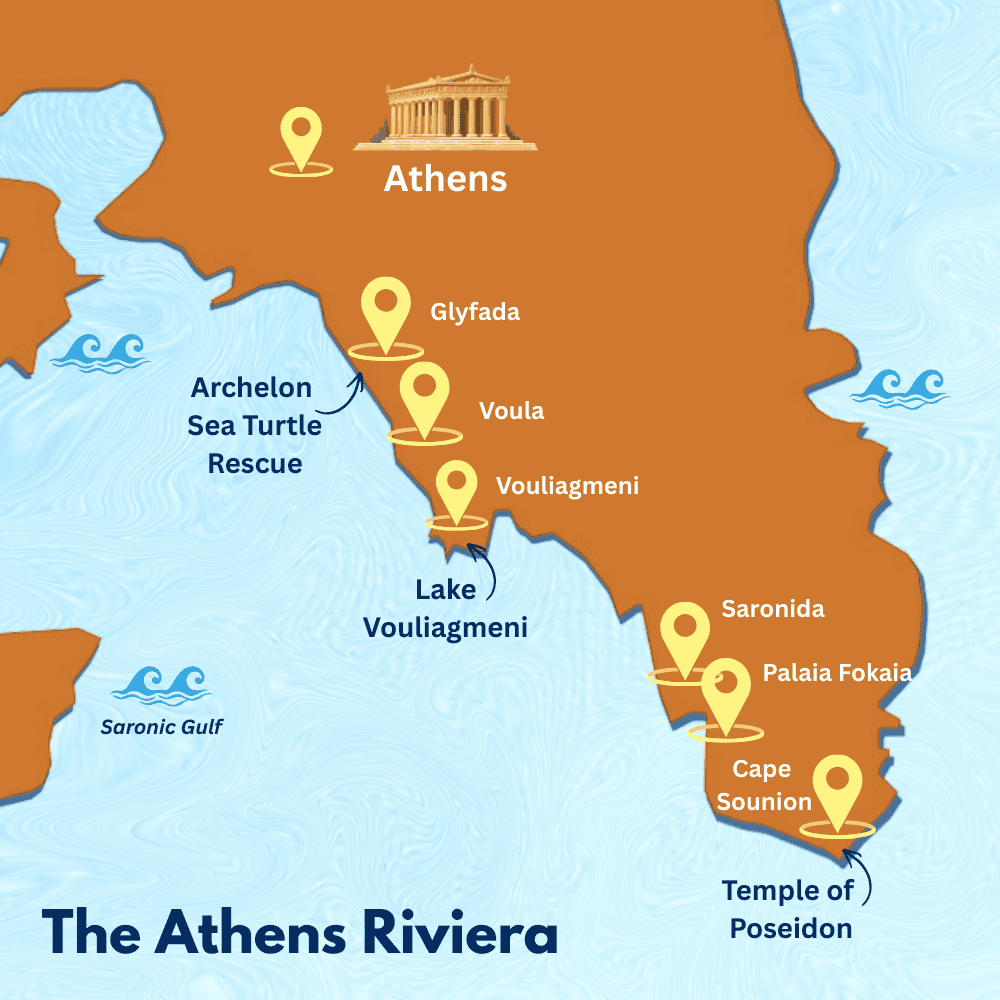
Lake Vouliagmeni is located on the Athens Riviera, just south of the city, in the coastal suburb of Vouliagmeni. It’s about 25 km from central Athens, which usually means a 30–40 minute drive, depending on traffic.
The lake sits close to beaches, cafés, and seaside restaurants, which makes it easy to turn your visit into a relaxed half or full day visit to the Riviera.
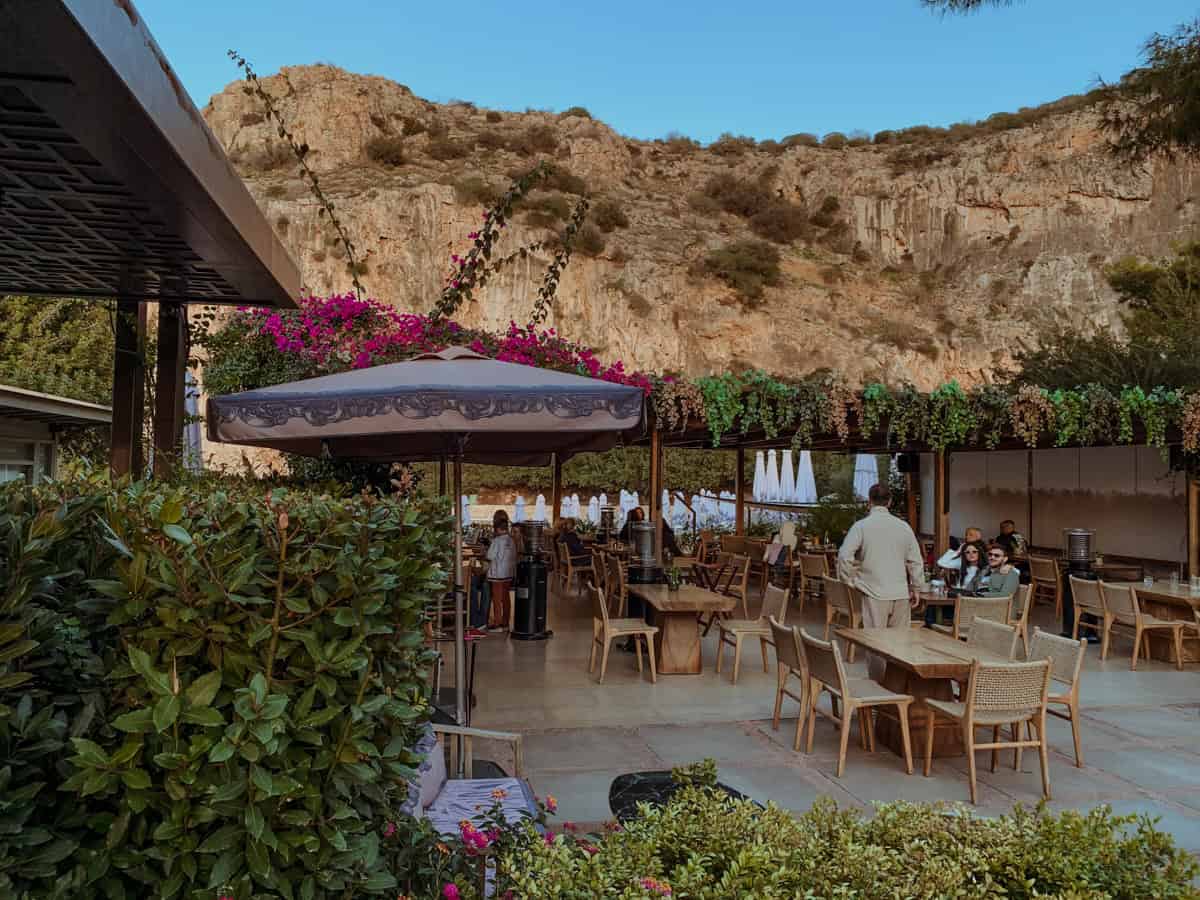
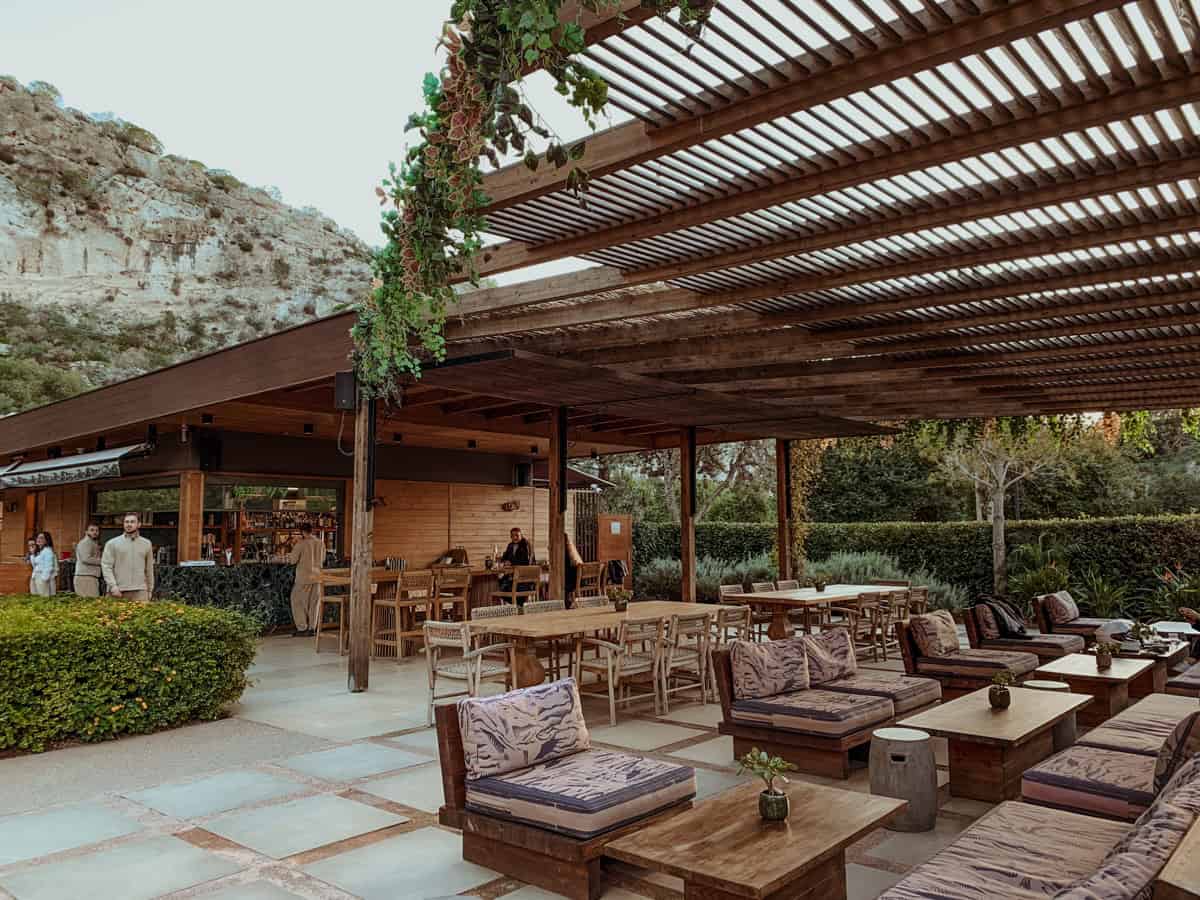
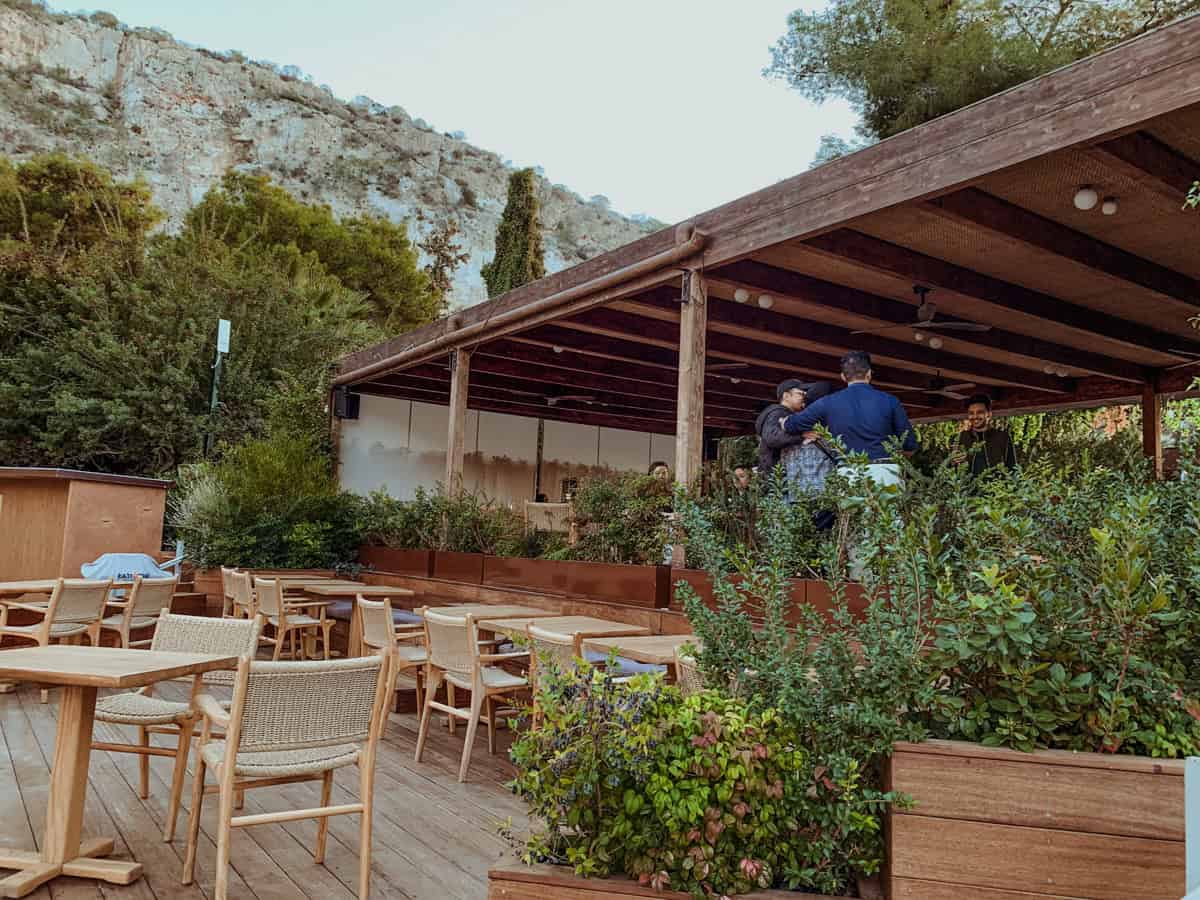
Besides, there’s a restaurant at the lake, so you don’t have to leave the site at all. It’s also on the same coastal route as the Temple of Poseidon, which is why many people combine both stops in one day trip.
How to get to Lake Vouliagmeni?
Lake Vouliagmeni is pretty easy to reach. We visited by rental car from our apartment in Saronida (and combined it with a trip to Archelon Turtle Rescue in Glyfada), but you can get there by private or shared tour, by car, by public transport or even with the hop on hop off bus.
💁♀️ By tour
Tours work well because everything is planned out for you, and they often combine Lake Vouliagmeni with other Athens Riviera highlights like one of the many beautiful beaches and the Temple of Poseidon.
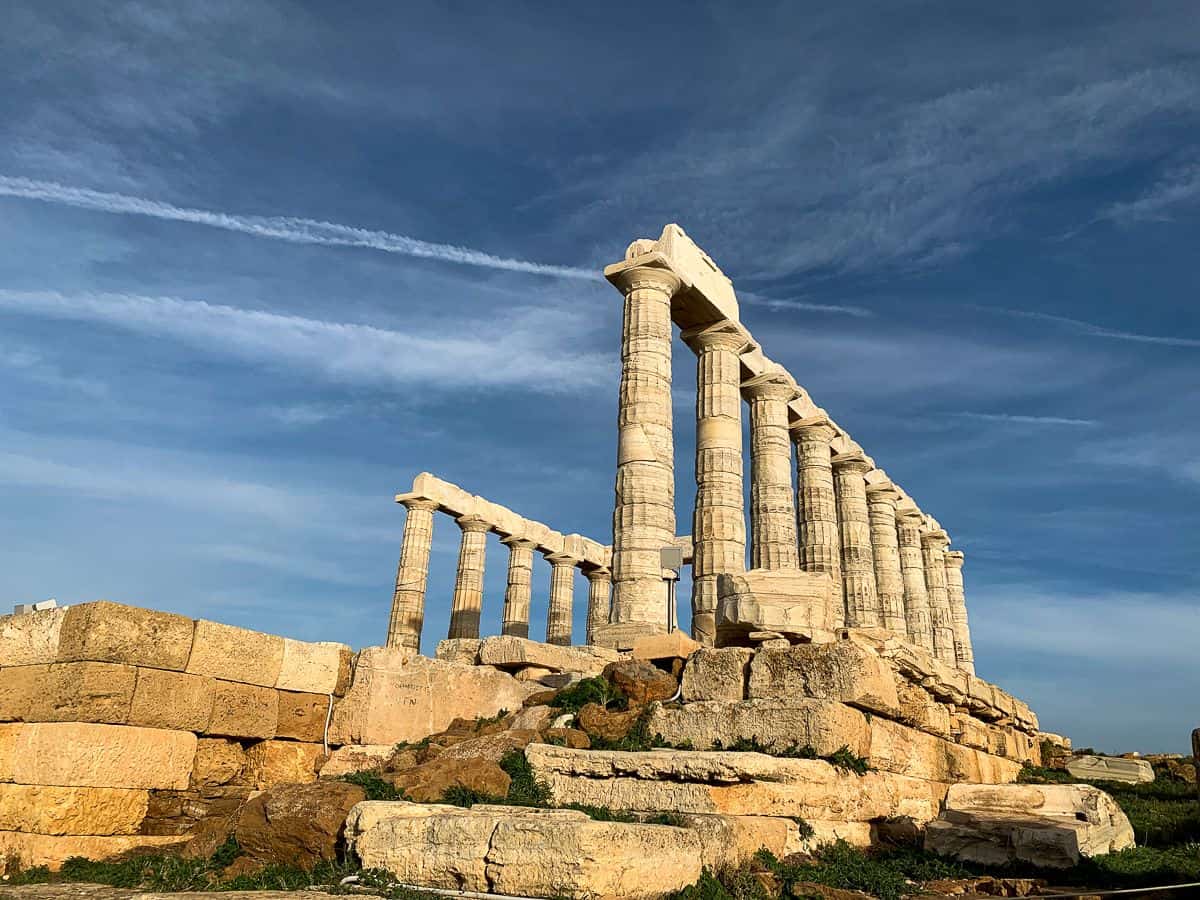
The downside is that you’re on a fixed schedule, so if your kids are tired or overstimulated, you can’t just go back home.
You’ll find both small-group and private tours to get to Lake Vouliagmeni. If you’re travelling as a (bigger) family, it’s worth comparing the costs, as a private tour may turn out to be more or less the same price.
Entrance to the lake is not included in the price and kids aged 6+ need to pay as well, so keep that in mind.
There aren’t that many tour options to visit Lake Vouliagmeni, so I will list the best ones here:
⭐️ Private full-day tour to Lake Vouliagmeni & Temple of Poseidon
⭐️ Small-group full-day tour to Lake Vouliagmeni, Temple of Poseidon & Kape Beach
🚗 By car
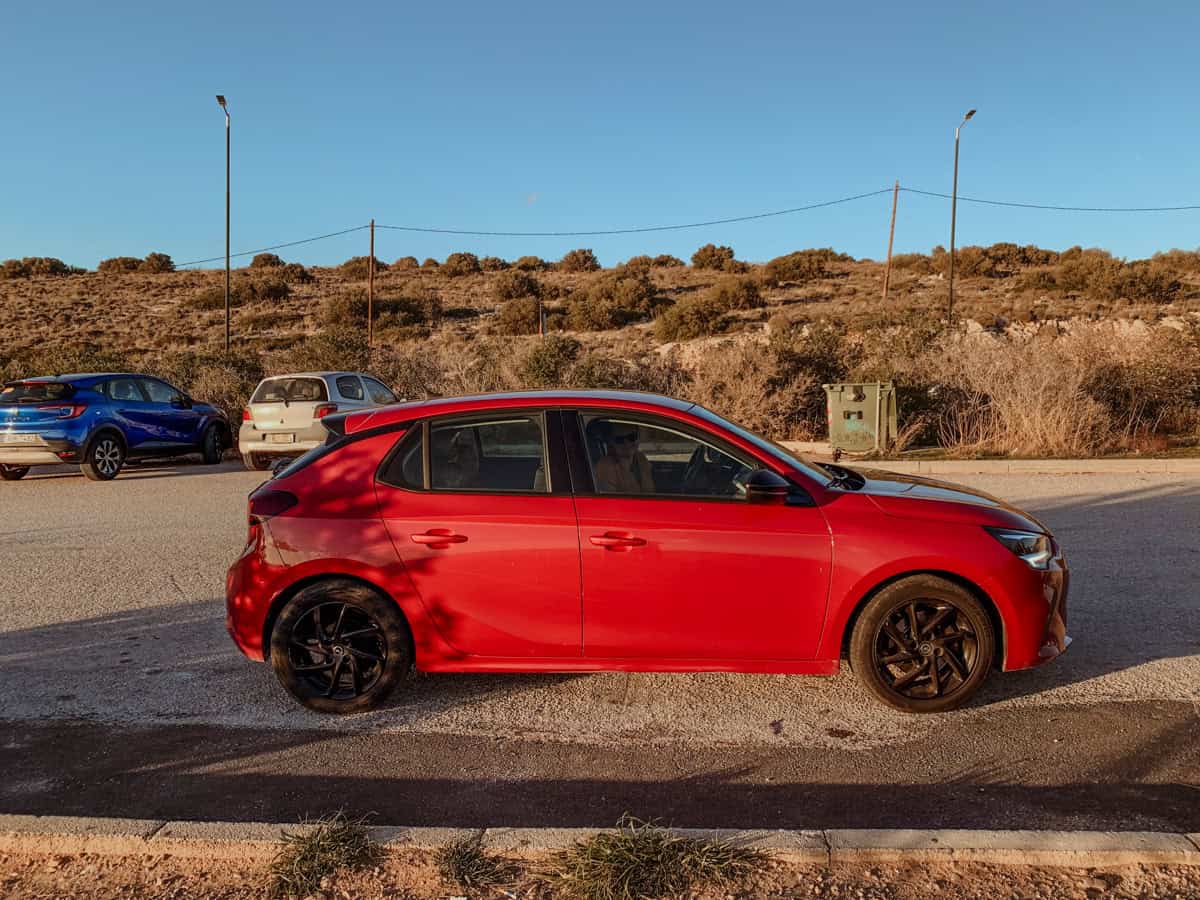
Getting to Lake Vouliagmeni by car was very easy and, honestly, the least stressful and most flexible option for us.
We drove from our rental apartment in Saronida to the Archelon Turtle Rescue in Glyfada and then back south to Vouliagmeni. The coastal road is simple, well-maintained, and relatively calm once you’re past the busier suburbs.
There are several free parking lots available. We parked at the parking closest to the lake (you drive down through the entrance), but there was another one outside the gate.
We rented our car through Sunny Cars, and I really liked that everything was included upfront, with no surprises (later on our trip, we had some car trouble, and it was so good to know that we wouldn’t have to pay a thing).
If you’re coming by car, I recommend you stop at the viewing point at Faskomilia Hill first. I only found out about it later, so we unfortunately missed it, but the pictures look so great!
🚊 By public transport
You can get to Lake Vouliagmeni by public transport, and on paper,( it’s pretty simple. From the city centre, take metro line M2 (the red line) to the last stop, Elliniko, and then switch to bus 122 to the lake (bus stop Limnē will bring you right across the street from the entrance).
That said, it does mean using (at least) two different types of public transport, which might be a lot for neurodivergent kids, especially since public transport in Athens is (nearly) always crowded.
We’ve used the metro plenty of times and it was great (but busy). However, when we took the bus (during our 2-week stay in Athens, not to get to Lake Vouliagmeni but to another place on the Athens Riviera), it didn’t show up, and we had to wait for the next one 20 minutes later, which wasn’t ideal.
Once you’re on the metro or the bus, things are clear and predictable: stops are announced and shown on screens, in both Greek and English. So yes, it’s convenient and definitely doable, BUT keep in mind how it will be to do the same trip back after a half or full day of swimming.
🚌 By hop-on hop-off bus
The last option is to visit Lake Vouliagmeni with the Athens hop-on, hop-off bus. That might sound surprising as it’s not in the centre, but there are actually 3 lines: one in the city centre, one to Piraeus and one to the Athens Rivièra.
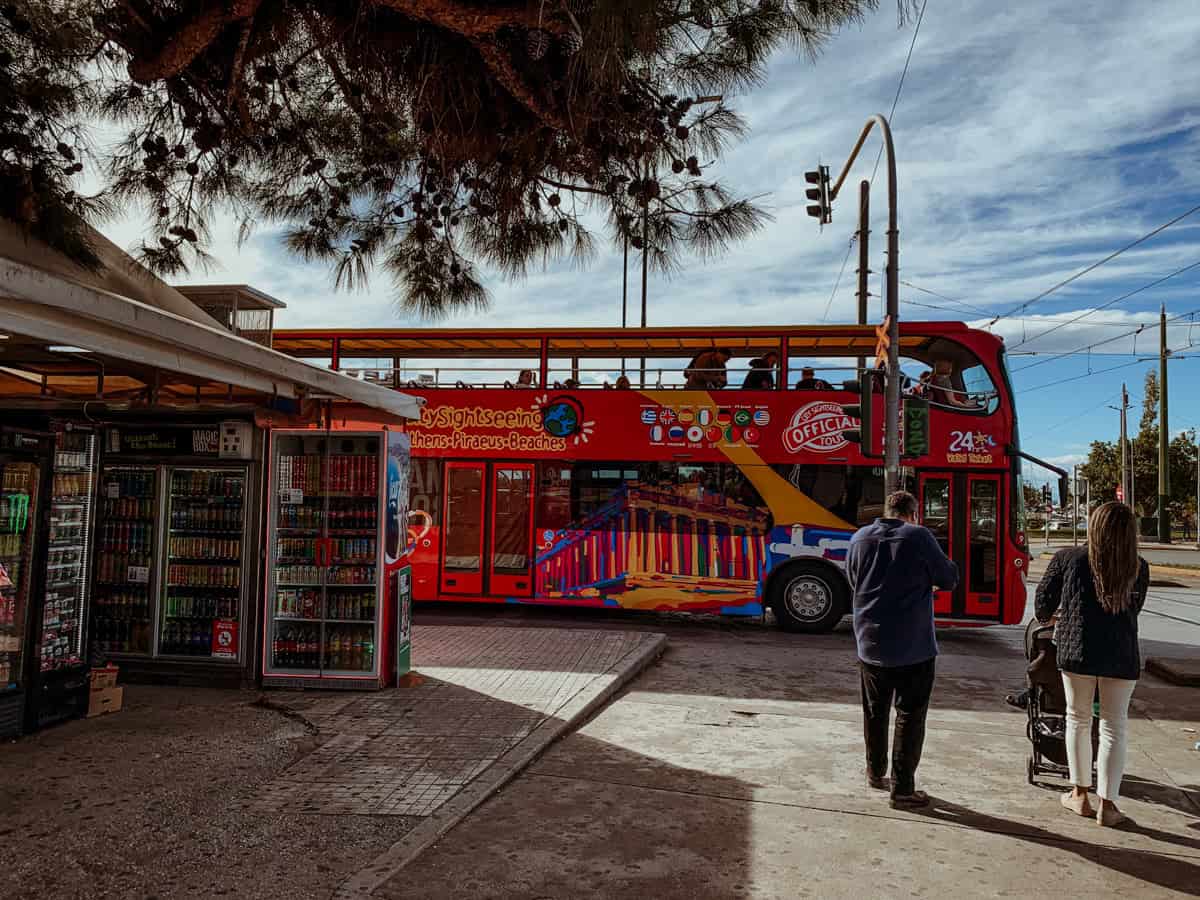
The hop on hop off bus in Athens isn’t that straightforward, so I wrote a deeper post about it here (coming soon). However, basically, you have 3 different companies (red, brown, and blue buses) that all offer the same 3 routes (with slight differences).
With City Sightseeing (the red bus), you can book a 48-hour or a 72-hour ticket for all 3 lines. This will cost you €28 (48hrs) or €35 (72hrs) for adults. Kids aged 6-12 pay €12 (on both tickets).
However, downsides are the limited departure times (11:00h, 13:00h and 15:00h) and the departure location (at bus stop “A2”).
Practical details for visiting Lake Vouliagmeni
🎫 Entry fee
A regular ticket is €17 on weekdays and €19 on weekends and national holidays. Kids 6 and older pay €14/€17. Definitely bring towels because you can get them there, but it costs €40.
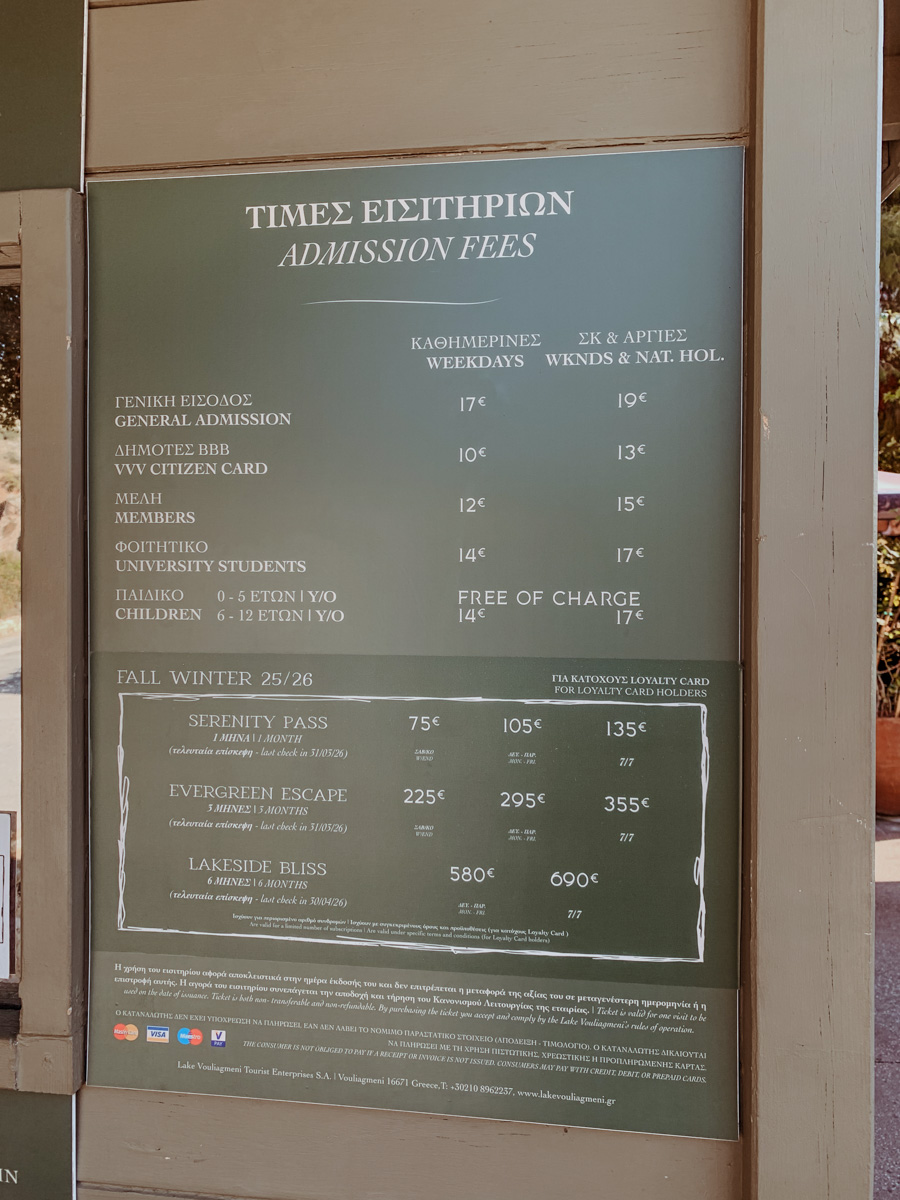
Sunbeds and chairs on the main deck are included in the regular entry but are first-come, first-served. Not a problem when we were there at the end of November, but in summer, I can imagine that being very different.
If you want a guaranteed spot or a bit more comfort, you can book one of the upgraded seating areas in advance. These are optional and always on top of the regular entrance fee.
- “Under the Pines” private area: quieter and shaded. Prices start around €45–55 per adult, with a reduced rate of €25 for children aged 6–12.
- Waterfront seating options: A simple lounge chair set for two starts at around €40–50, while sunbed sets are usually €70–90. Cabanas cost more, starting at roughly €80–100 for two people, and larger setups for families (a cabana plus extra lounge chairs) can go up to €115–140.
- Comfort seating on the main deck: starts at around €60–70.
These upgrades only make sense in high season, when sunbeds can fill up quickly.
When we visited in low season, the standard entry was more than enough, and we didn’t feel the need to reserve anything extra (nor did anyone else!). Besides, most of the upgrade options aren’t available in winter.
Dressing rooms, showers, lockers and toilets are free.
There’s a restaurant/snack-bar on site, and you’re not allowed to bring your own food & drinks, so if you plan on spending more than a couple of hours, you’ll have to budget for this (although, when we were here, many people were eating snacks they brought along).
⏱️ Opening hours
Lake Vouliagmeni is open year-round, but the opening hours change with the season, so it’s worth checking before you go.
- May – mid September: 8:00h – 20:00h
- Mid November – February: 8:30h – 16:30h
- Mid September – mid November: 8:00h/8:30h – 19:00h/17:00h (depending on sunrise and sunset)
- March – April: 8:30h – 18:00h/19:00h (depending on sunrise and sunset)
When to visit (and when to avoid)
If you’re looking for fewer people and lower noise levels, earlier in the day is usually best. Late afternoons can also be quieter outside of peak season, but in summer they’re often busy right up until closing.
The difference between summer and winter is – unsurprisingly – big.
- In summer, the lake is lively and popular, especially from late morning onward, and weekends are crowded.
- In winter and the shoulder season, things are slower and more relaxed. It comes with colder water, though.
Weekdays are noticeably calmer than weekends and school holidays.
We visited on a Sunday at the end of November and arrived around 14:30h. There were some people around, but it didn’t feel busy.
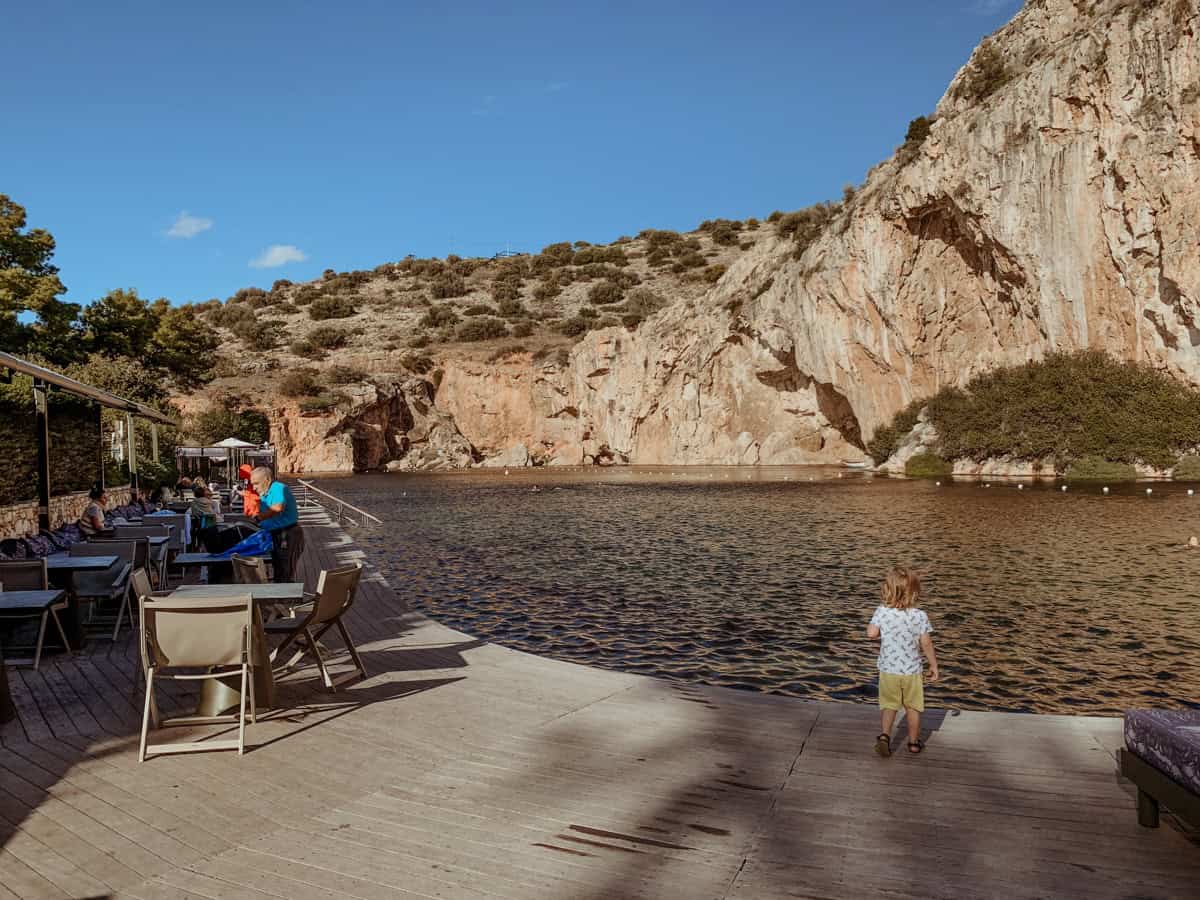
I’d guess around 20 people in total, and about 70% of the sunbeds on the main deck were filled at that point.
As the afternoon went on, more people started leaving, which wasn’t surprising with sunset around 17:15h. By 16:00h, you could no longer sit in direct sunlight, and it got chilly very quickly.
What the experience is like (so you can visualise it)
👉 Arriving & entry
When you arrive, you drive through a gate and down a short driveway. We hesitated for a moment because there is a small parking lot on the left-hand side before the gate, but you’re allowed to drive all the way in, and there’s more parking at the end.
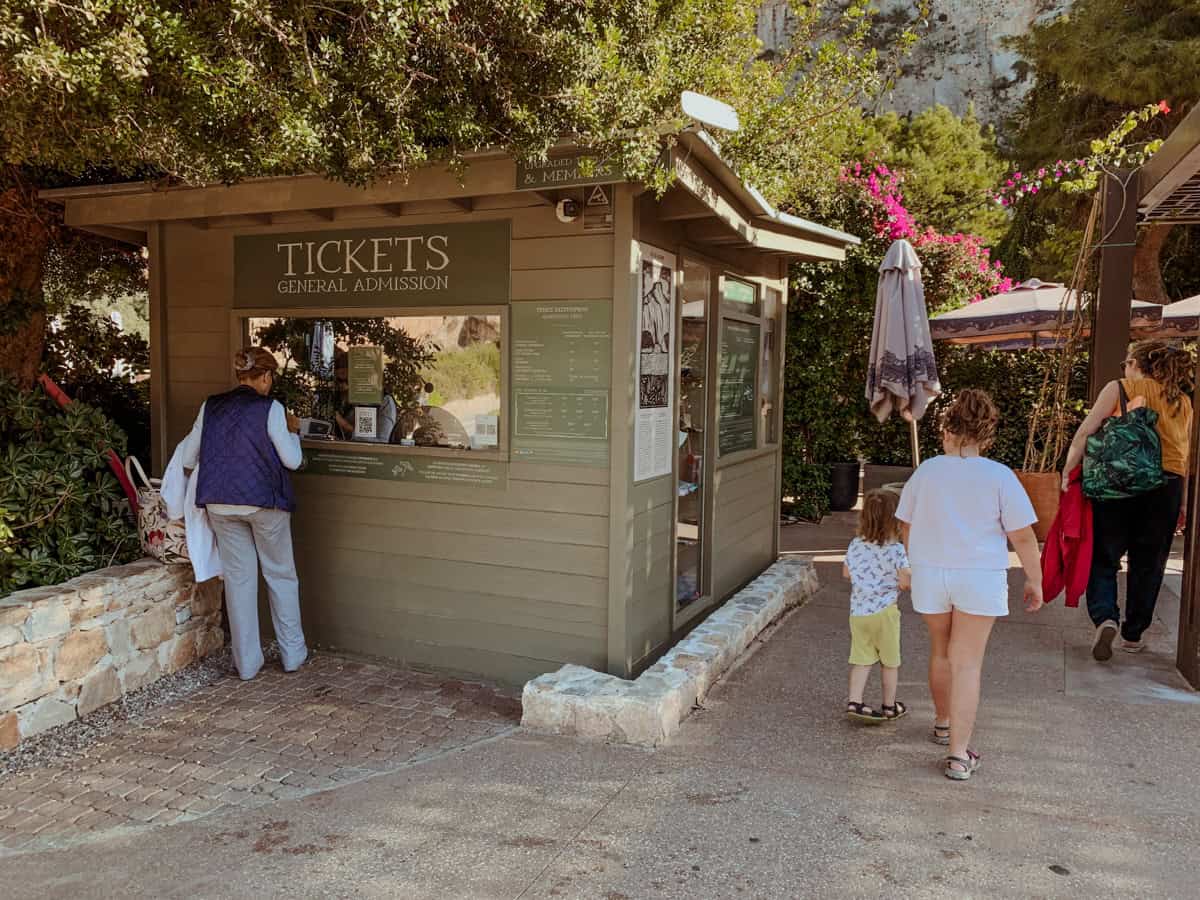
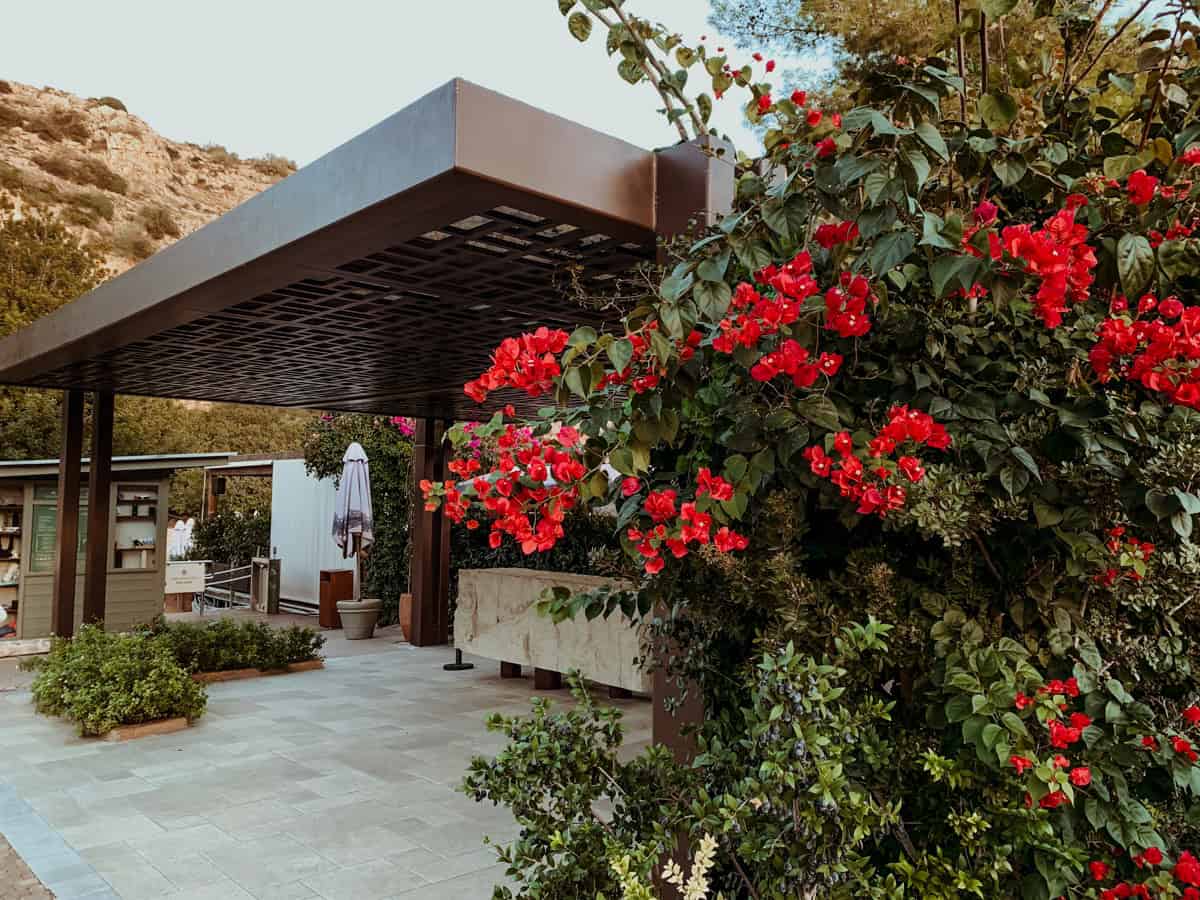
From there, you walk to the ticket booth, pay your entrance fee, and head down a short path toward the lake.
There’s a tiny shop in the ticket booth selling basics like goggles and swim gear, but it’s very expensive (€25 for goggles when we asked), so I wouldn’t rely on it.
Access to the restaurant is from outside the lake area, but once you’re inside, the staff walk around to take orders, so you don’t need to move if you don’t want to.
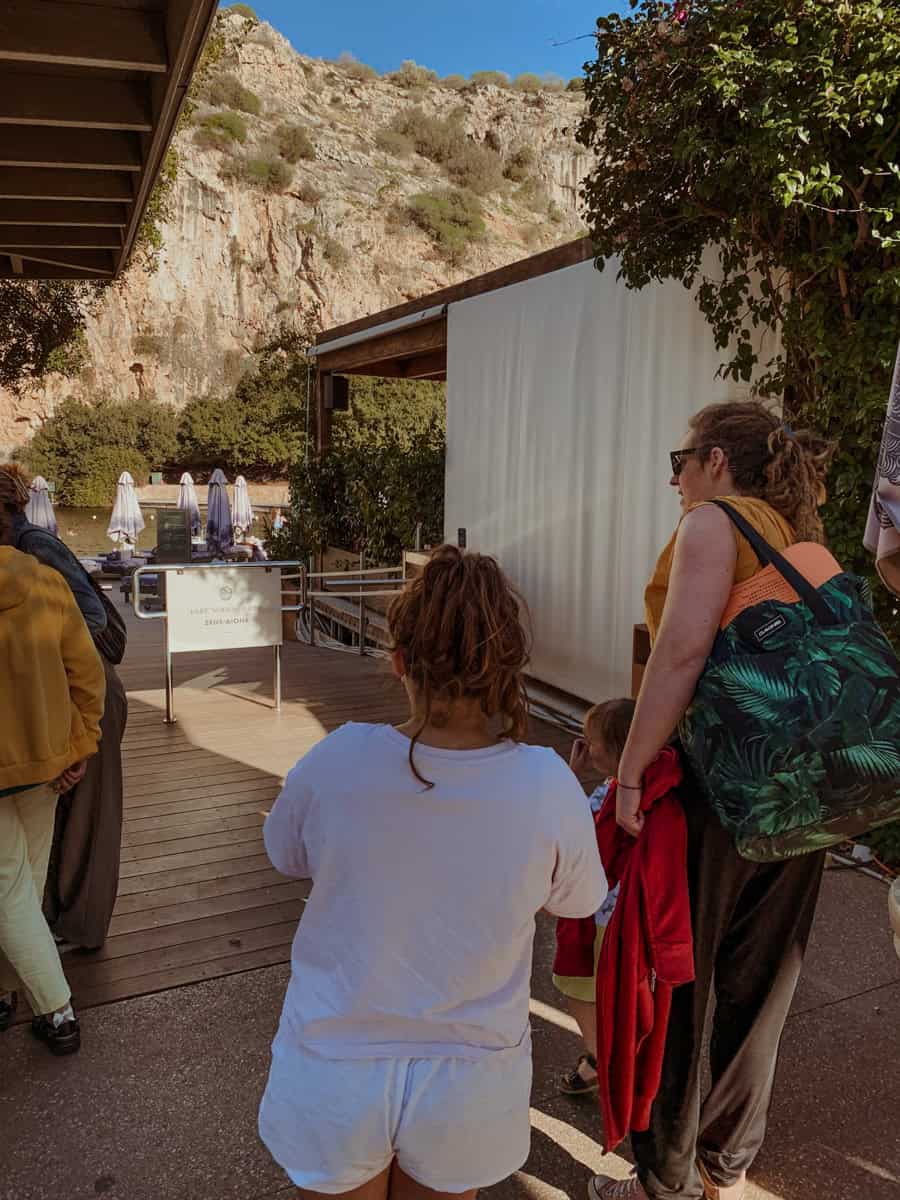
👉 Layout of the area
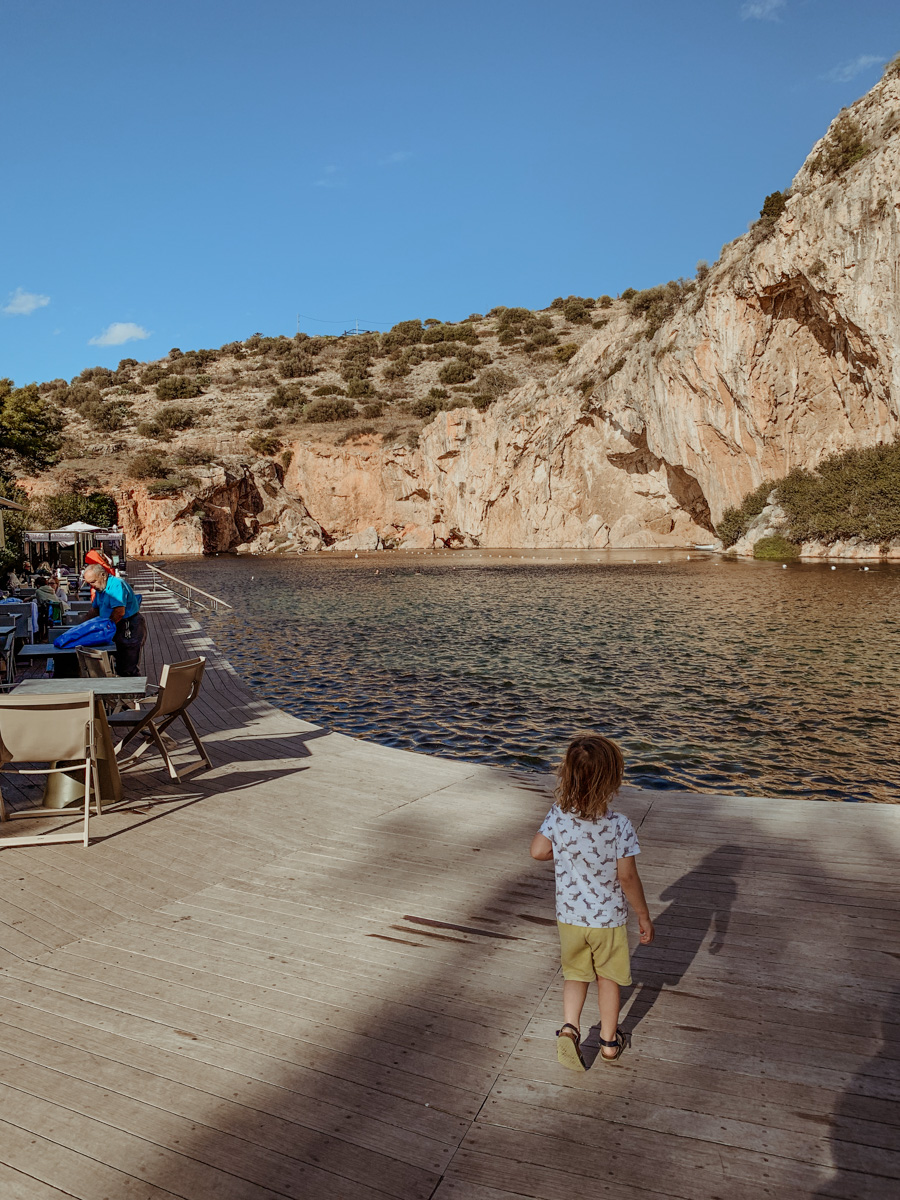
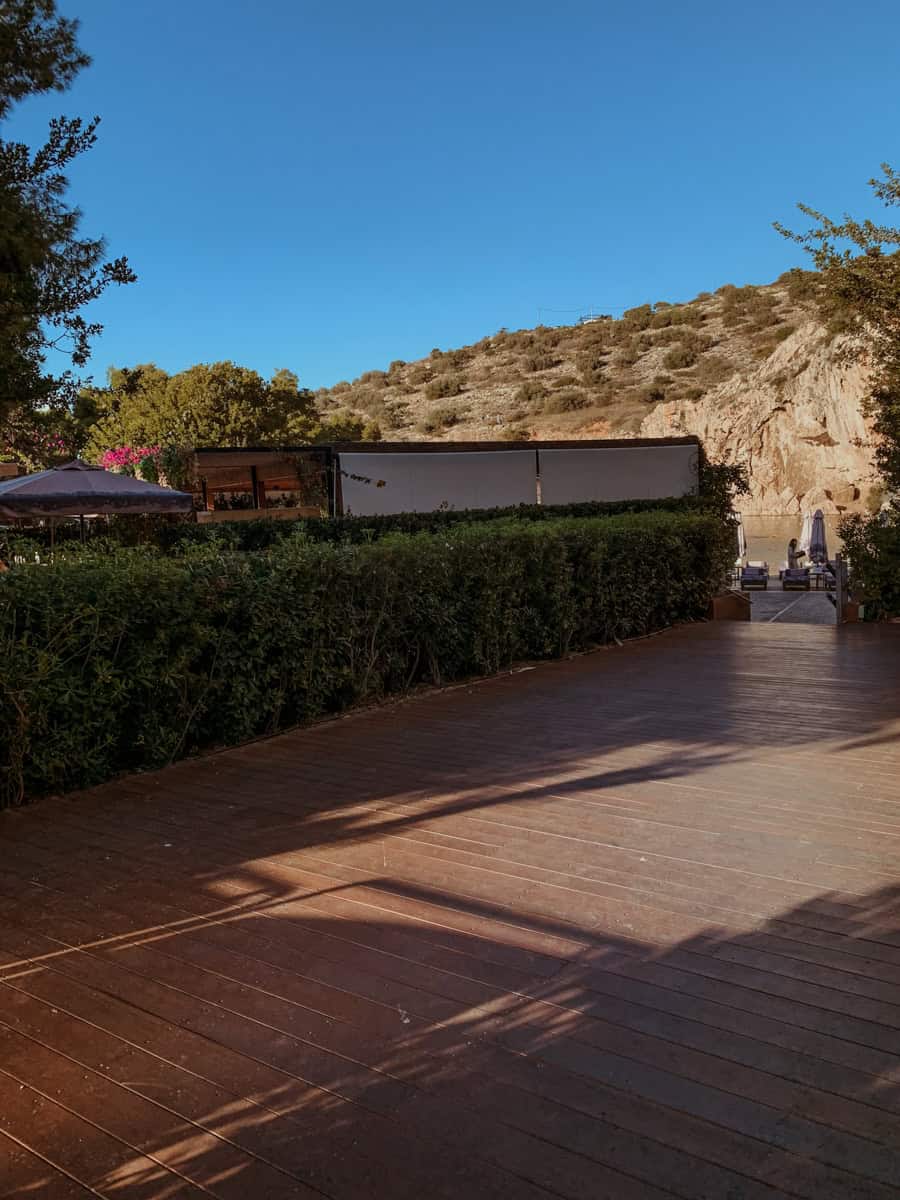
The lake area is laid out logically. You walk in with the restaurant on your right. From there:
- Go straight to the main deck, which is the area that’s included with the regular ticket.
- To the left, you can walk toward the waterfront seating and the pine tree area.
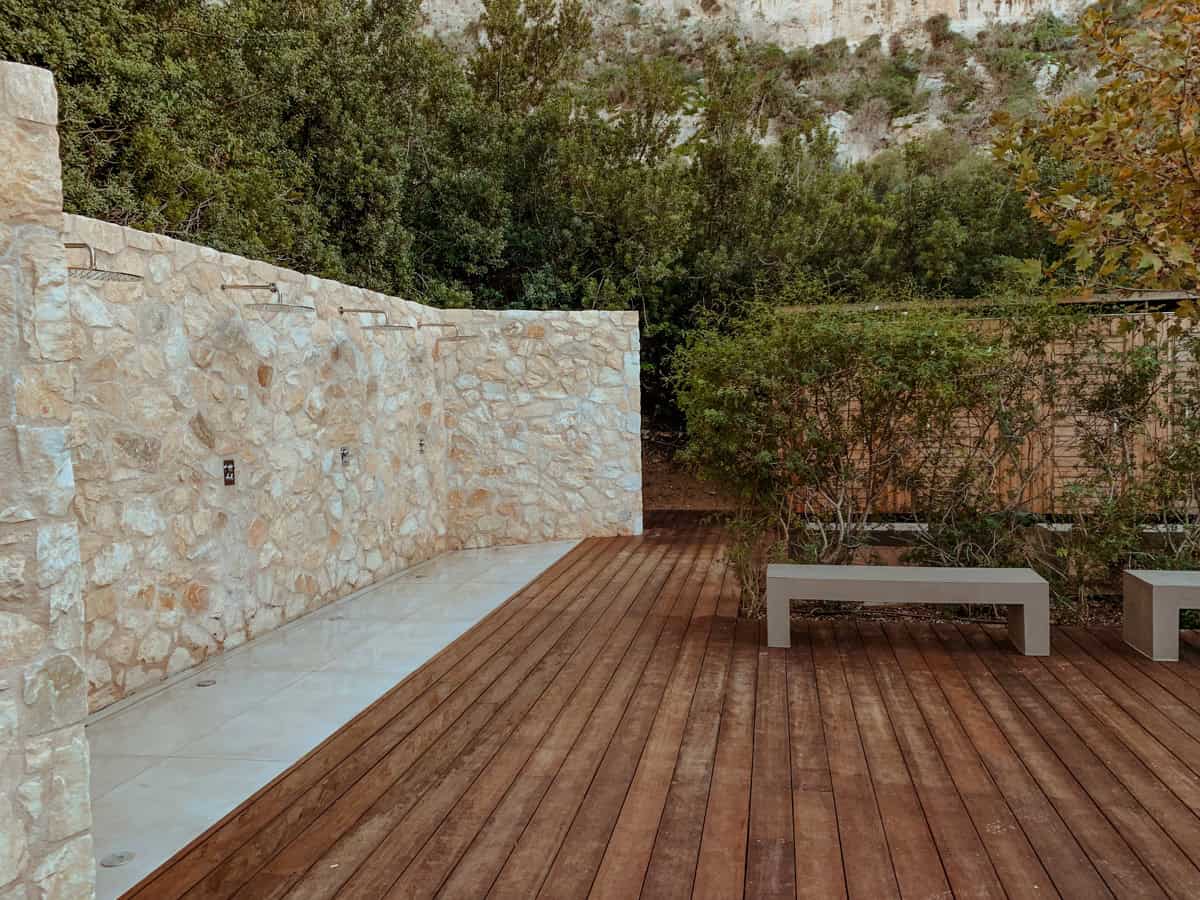
- To the right, a path leads to the showers, lockers, and toilets.
- Changing cabins are tucked away at the back of the main deck.
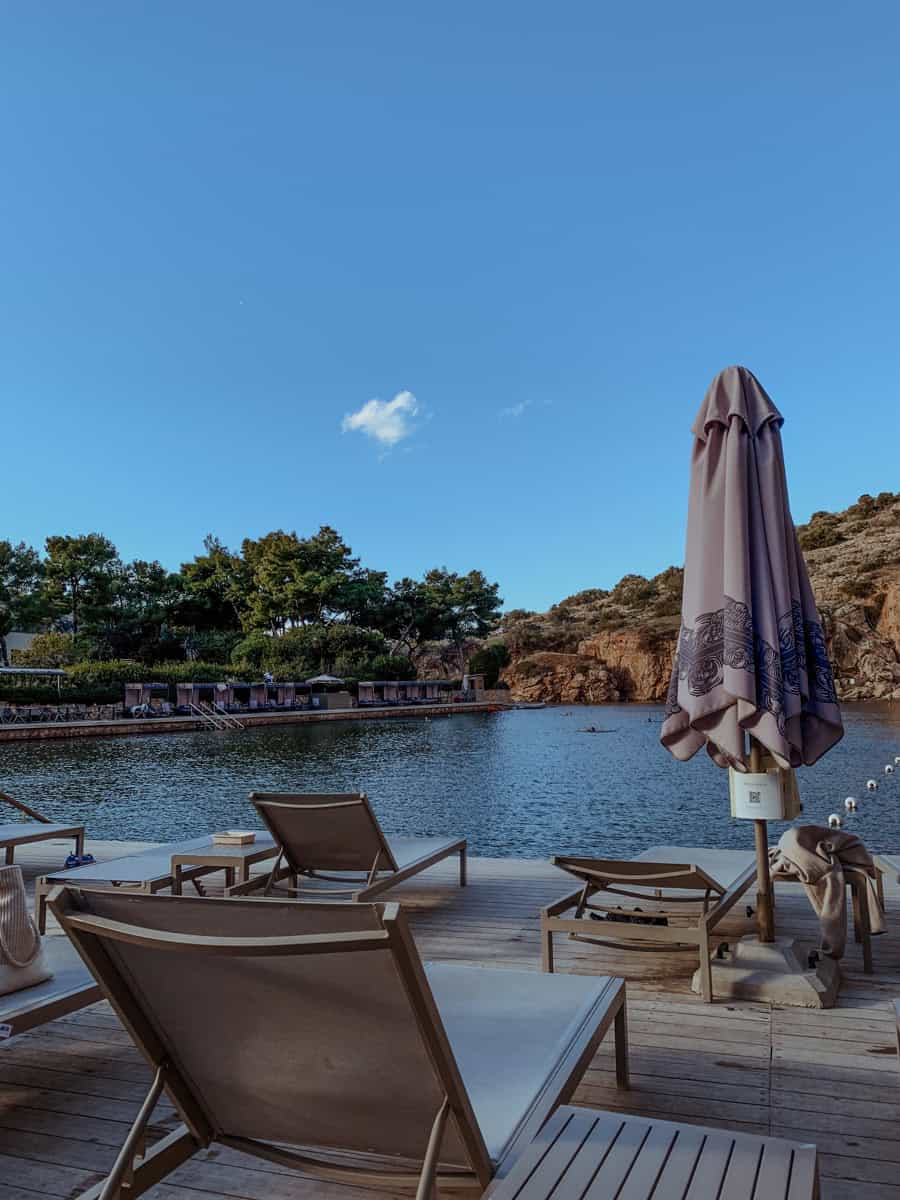
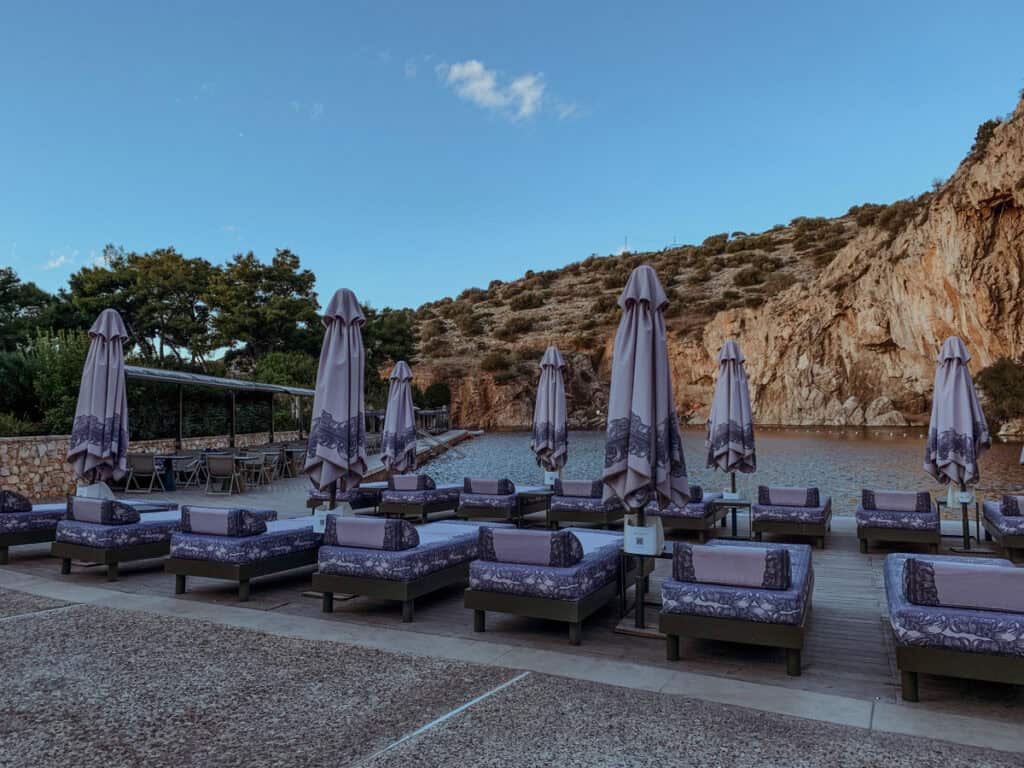
All seating on the main deck counts as part of the regular entry. That includes sunbeds, deck chairs, and the regular chairs around the bar area. As it’s first-come, first-served, you might end up with a bar chair.
In the low season, we had plenty of choices. We picked sunbeds in the sun, but once the sun dropped lower in the afternoon, we had to move around a bit to avoid sitting in the shade. Each umbrella has a small lockbox underneath, which was really handy for phones and small valuables.
I also loved the long wooden bench at the very end of the main deck. Some cats were hanging around and I could catch the last sunbeams of the day.
👉 Swimming & water access
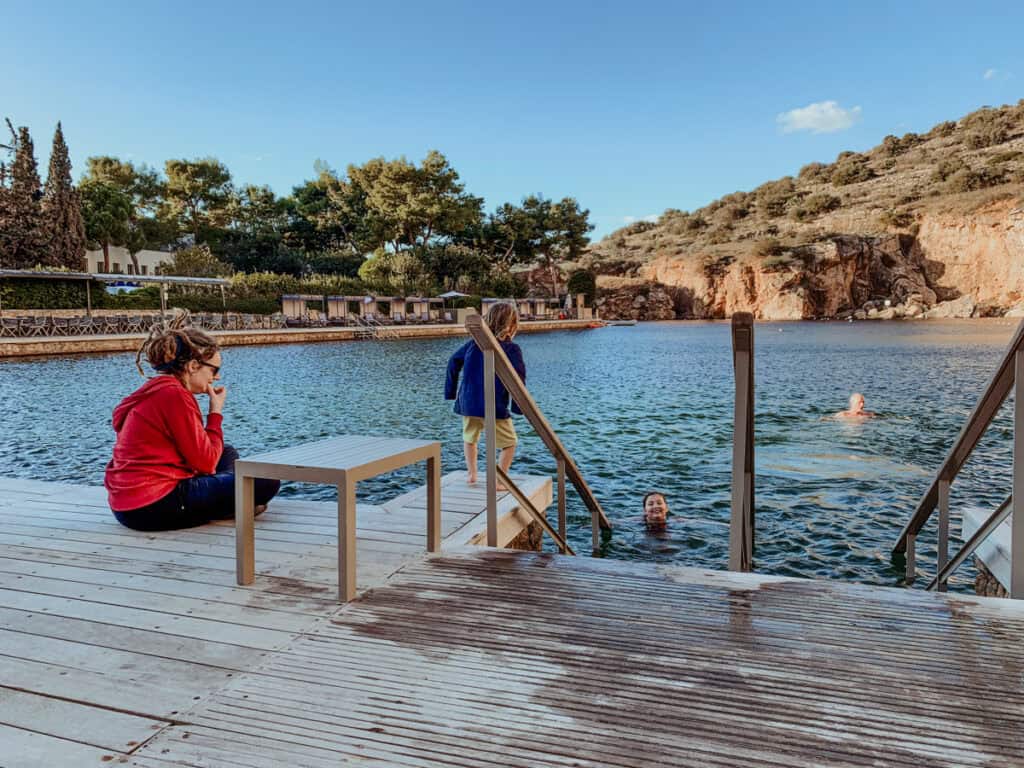
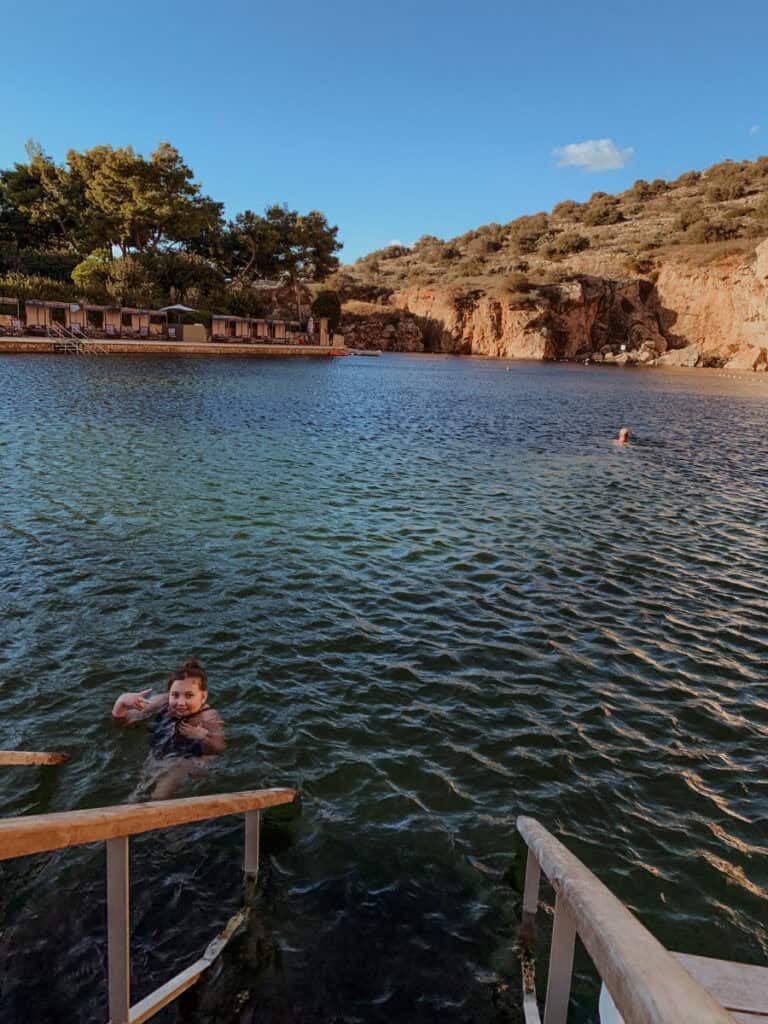
Don’t let the words thermal lake fool you; this is not hot water. The lake stays between 21–29°C year-round, which is pretty cold, especially if the air temperature isn’t much higher.
When we visited, it was about 21°C outside and 24°C in the water. There’s a huge digital thermometer on the side that tells you the outside, lake and sea temperature in real life.
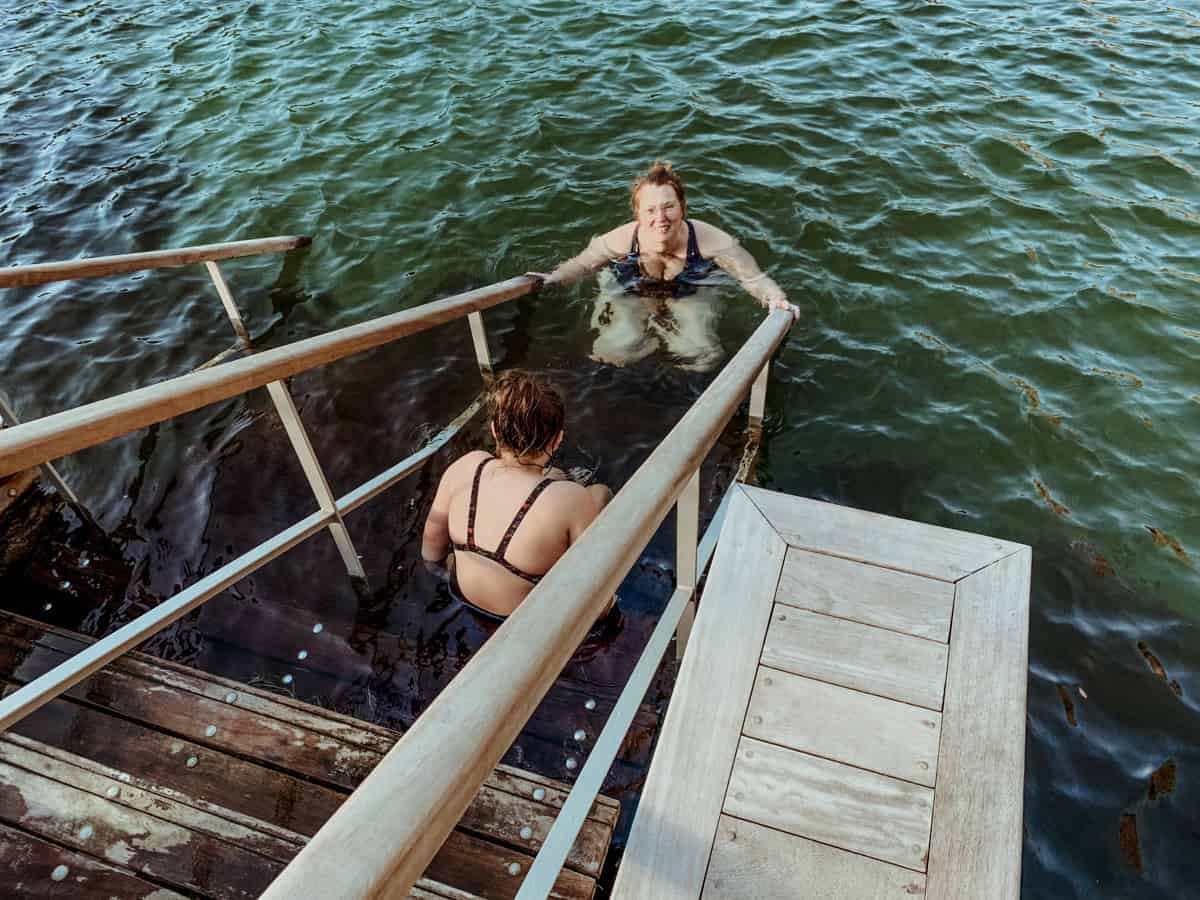
I went in with our oldest, but my wife and our youngest couldn’t handle the cold and stayed out (which was hard on my youngest because we promised them swimming).
There are wooden steps and ladders into the water, but they can get slippery, so go slowly. This is also where most of the fish hang out.
Once you’re fully in and moving, the water feels much more manageable. Getting out and warming up again was harder, especially since the sun was setting and shade took over quickly.
It’s very easy to sit out, take breaks, or decide not to swim at all. Plenty of people were just relaxing on loungers, while others were in the water.
👉 Doctor fish
Yes, the fish are real. And there are a lot of them.
Near the steps, they will nibble your feet and legs, hundreds at a time if you stand still. My daughter loved it and stayed on the stairs for ages, but I can easily imagine this being overwhelming or scary for some kids (and adults).
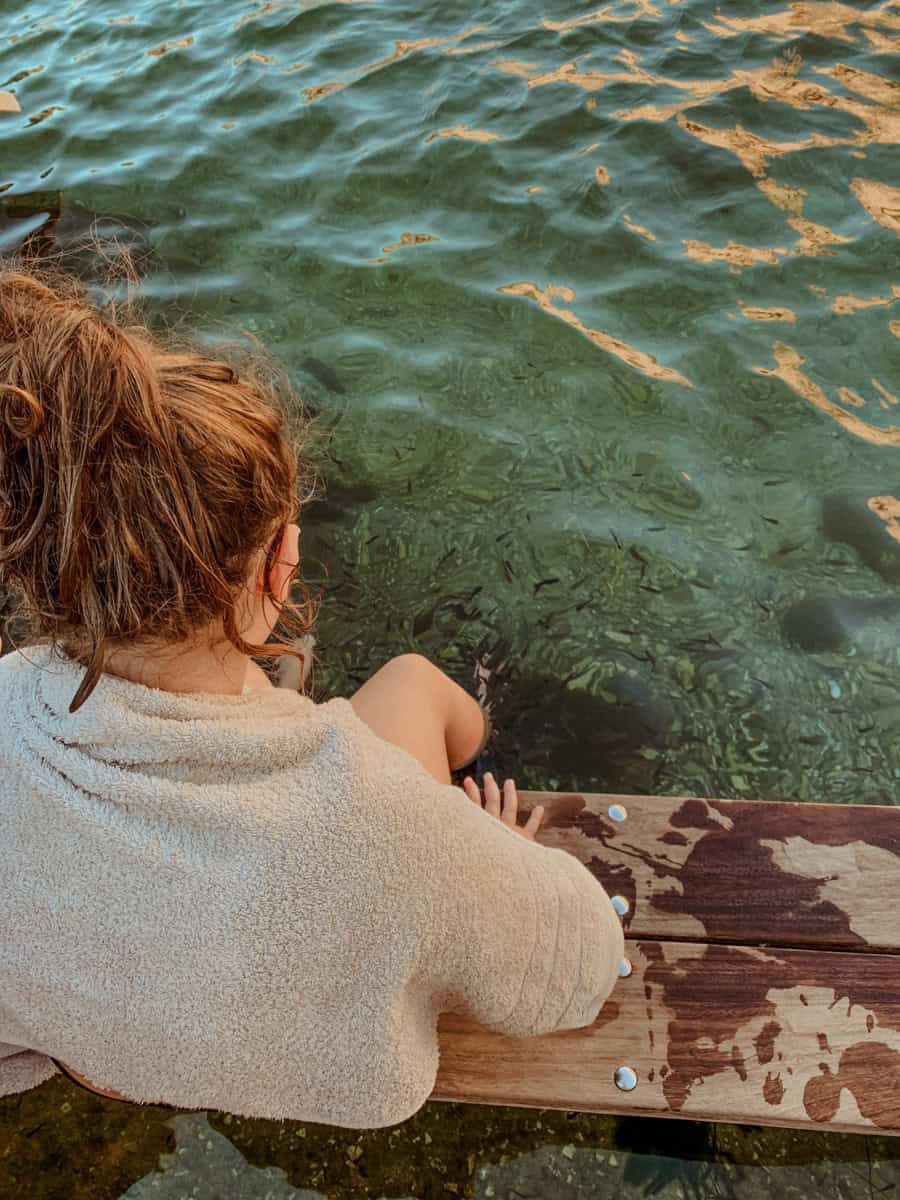
The good news: if you swim just a few metres away from the edge, you don’t feel them anymore.
There are benches in the water near the main deck, which is also where people tend to “do” the fish spa experience on purpose. Next to it is the wheelchair lift.
👉 Depth & feeling safe
We swam as far as the pine tree area. I could stand everywhere I went (I’m 1.68m), though my daughter (1.40m) couldn’t always. I never experienced sudden drop-offs, but reviews online mention deeper areas closer to the rope with white buoys.
We didn’t go that far, and honestly didn’t feel the need to as we had sooo much space in the water (maybe 10 people in the water?).
There is some algae in the water, which you can feel now and then, but it didn’t bother us. The water also isn’t super super clear.
👉 Food & drinks
You’re not allowed to bring your own food or drinks, which makes this a pricey outing for families. You can scan the QR code on your umbrella to see the menu, which consists of cocktails, coffee, snacks, desserts and more.
We kept it simple: ice creams for the kids and a cappuccino for me. You don’t need to queue anywhere, waiters walk around and take orders at your sunbed. At the end, they’ll ask if you want to add a service charge to the bill.
👉 Noise, atmosphere & staff
We visited on a Sunday at the end of November on a beautiful sunny day, so a weekend day but in low season. There were people around, but not many, maybe 20 or so on the main deck.
Noise levels were low, there were hardly any kids, and there was no loud music (I honestly can’t remember if there was any music at all).
The overall vibe felt calm, a bit posh, and slightly distant in terms of friendliness, not warm and chatty, but also not unfriendly. But the setting is so beautiful that it more than makes up for it.
👉 Accessibility
The main deck is wheelchair accessible, and there is a chair lift available to help wheelchair users enter the water. We didn’t see it in use, though and have never used one, so I don’t feel like I can share any important details about it except letting you know that it was there.
It’s important to say this clearly: we visited in low season, and I think that made a huge difference. In summer, with higher temperatures, more kids, fuller sunbeds, and longer days, the sensory load will almost certainly be much higher. The space itself doesn’t change, but how it feels absolutely will.
For us, despite the cold water, it was a really good experience and I loved the high cliffs and the water colour. I’d go back in a heartbeat, but I’d be very intentional about timing if we ever visited in high season.
👉 Facilities
As mentioned, Lake Vouliagmeni is a business and kinda feels like a posh resort. You can find the following facilities:
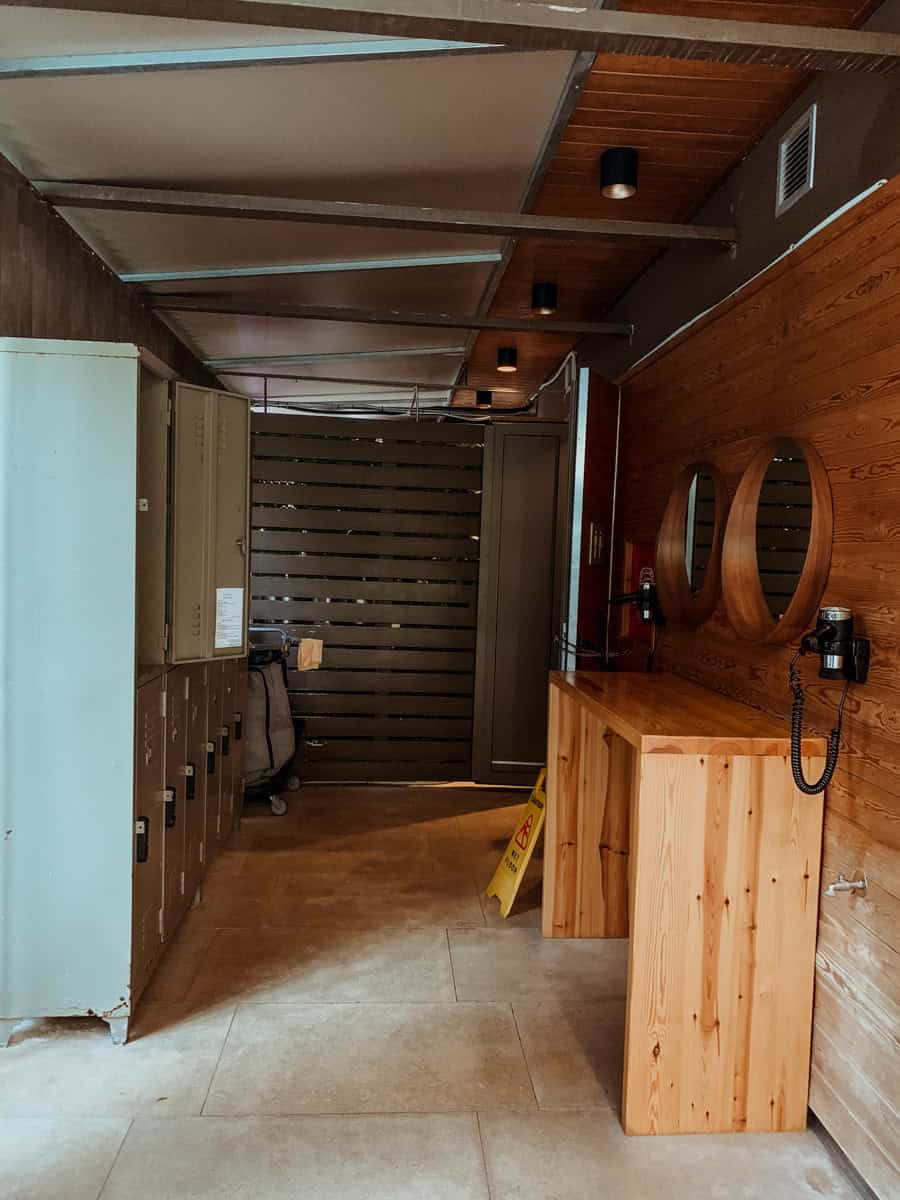
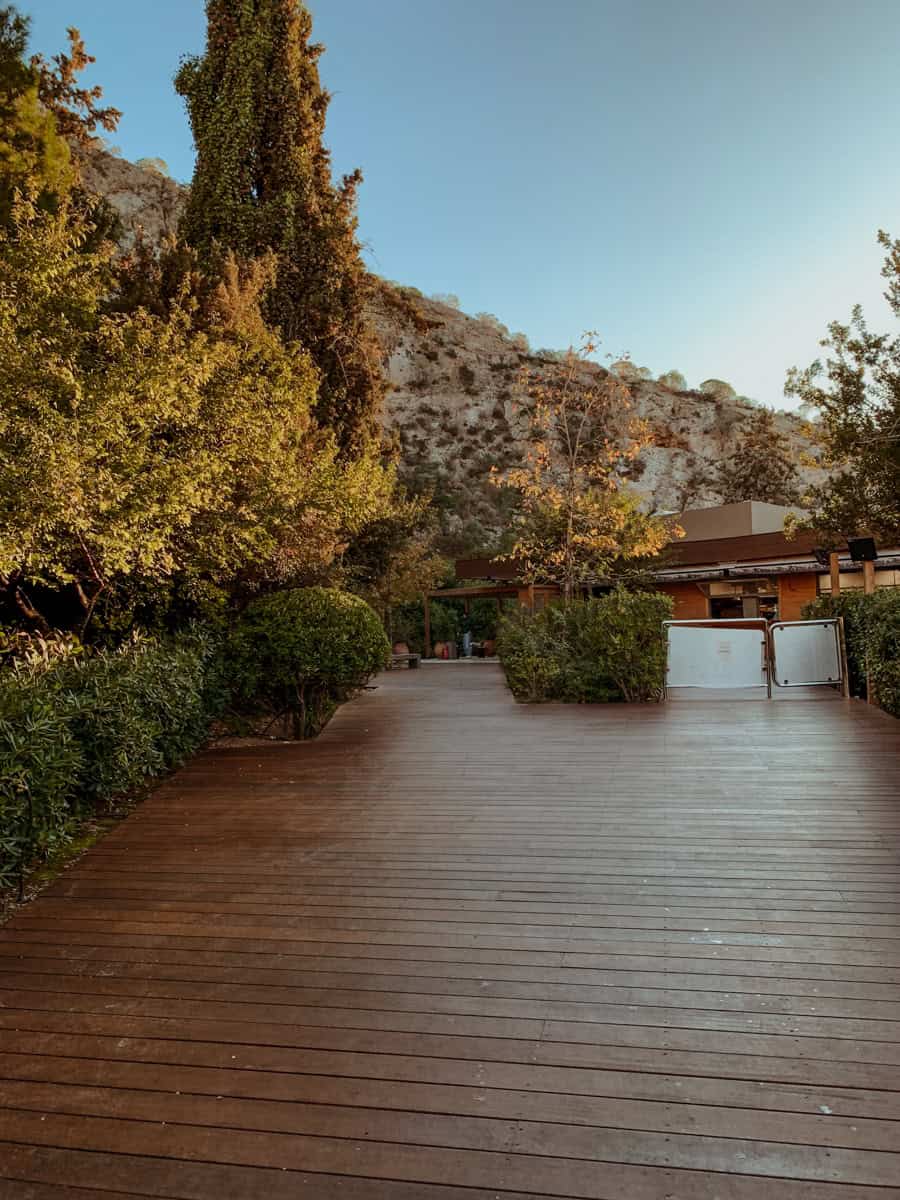
- Changing cabins: Available near the main deck
- Showers: On site; meant to have hot water, though reviews say this isn’t always the case (we didn’t try)
- Toilets: Limited (2×2), which may be tight when it’s busy
- Café/restaurant: Full-service, with waiters taking orders at your seat
- Shade & seating: Umbrellas are provided, but reviews mention they’re often kept closed due to wind, even in paid areas
- Lockers: Very limited (around 15); we felt fine leaving our things on our sunbed in low season
- Open-air spa: Offers massages and treatments using the lake’s spring water and the famous little fish exfoliation. Closed in winter.
Rules at the lake
There are plenty of rules that you’ll need to follow. Given that there weren’t many people around, we just read the sign that was up, but according to reviews, some of these rules were enforced strictly.
📌 No outside food or drinks allowed. This can be a tough one if your kids rely on safe or familiar foods. In reality, we did see people eating small snacks, but officially, it’s not allowed.
📌 No sunscreen in the lake. You’re asked to shower before entering, so UV swim shirts and hats are a good idea, especially for kids.
📌 Shower before swimming. This is mandatory to keep the water clean.
📌 No jumping or diving. Entry is only via steps or ladders.
📌 Swimming only in designated areas. Ropes and buoys mark where you’re allowed to go.
📌 Children must be supervised at all times. There’s a lifeguard, but keep an eye on your kids at all times, as is normal when around water.
📌 Quiet, relaxed atmosphere expected. Loud play, running, or ball games aren’t allowed.
Overall, the rules are there to protect the lake and keep the vibe calm, but they do mean you need to plan ahead a bit, especially around food and sun protection.
What to bring
🎒 Swim shoes: The steps into the water can be slippery and if you or the kids are sensitive to the weird sensation of the bottom of the lake, water shoes will do wonders.
🎒 Towels: You can buy towels onsite, but it’s very expensive. Definitely bring your own.
🎒 Goggles: Helpful if your kids don’t like water in their eyes; you can buy them onsite.
🎒 Sunglasses & sun protection: Sunscreen isn’t allowed in the lake, so UV swim shirts are a must in summer.
🎒 Sensory supports: Earplugs, fidgets, rash guards, or anything that helps with noise, cold, or body sensations.
🎒 Warm clothes: The water is (pretty) cold, especially if you’re visiting outside of summer, so bring something to warm you all up.
Combining Lake Vouliagmeni with other stops
As you’ll already be heading out of Athens to reach Lake Vouliagmeni, it often makes sense to pair the visit with other easy stops along the Riviera, just enough to enrich the day without turning it into an overpacked itinerary. I recommend adding just one other stop to avoid overwhelm or overtiredness.
⭐️ Temple of Poseidon
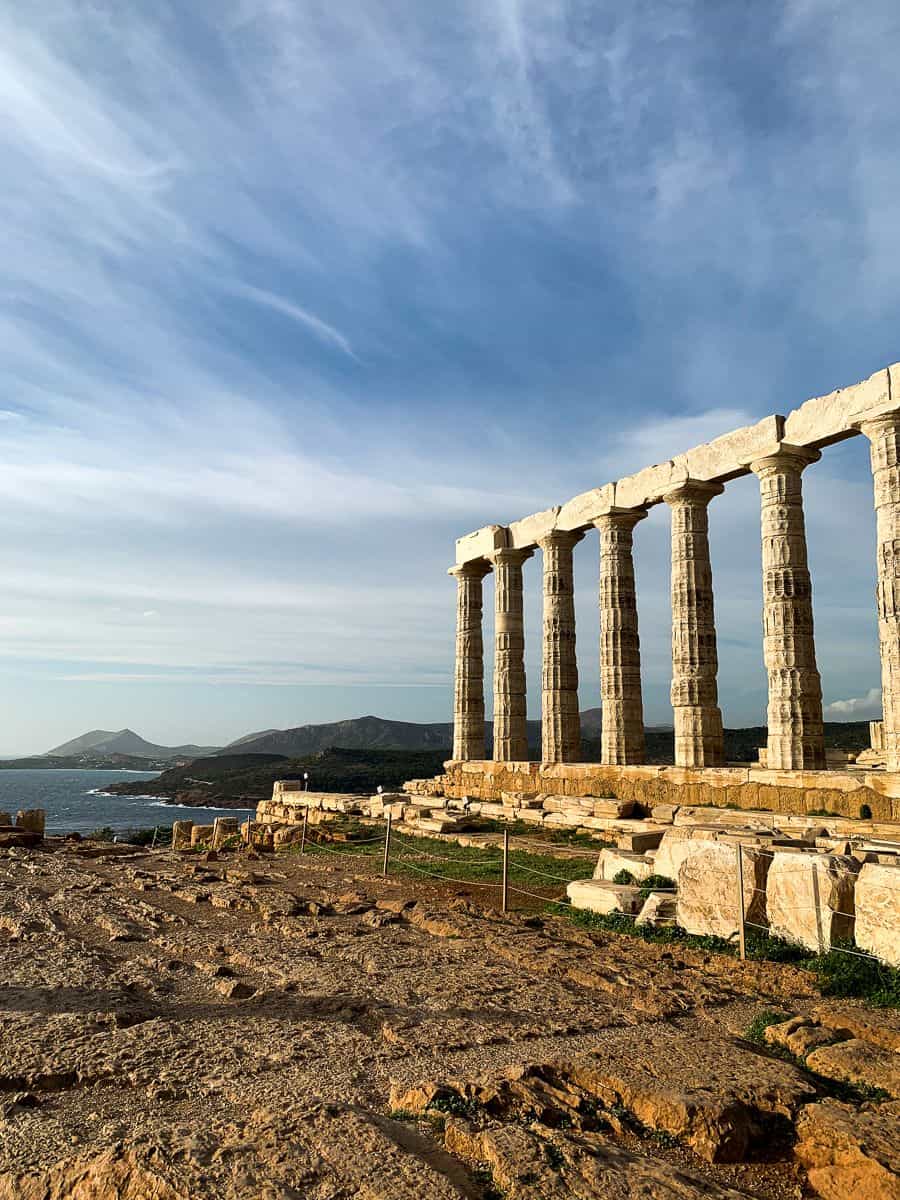
This is an easy and popular combo, especially if you have a car or book a full-day tour. Keep in mind that the temple is busiest at sunset, while the lake is usually calmer earlier in the day.
⭐️ Nearby beaches
Beaches like Kape or Legrena are close by and work well if your kids still have energy after the lake. That said, lake + beach might be a bit too much swimming for one day for some families.
⭐️ Cafés along the Riviera
Stopping for a simple lunch or coffee along the coastal road is often a better fit than trying to squeeze in another “sight.” It gives everyone a break without adding pressure.
More questions?
👀 Can you just look without swimming?
No, you can’t unless you eat at the restaurant. If you want sit on the deck and enjoy the setting without going into the water, you’ll have to pay the entry fee.
👦 Is Lake Vouliagmeni suitable for kids?
Yes, especially for calm, confident swimmers because there’s no shallow area. The water is cold for many kids, and the fish can be a sensory surprise.
🚶 Can you leave and re-enter?
All tickets are day tickets. You can leave and enter again, but not be outside the facility for more than one hour, because the ticket will be deactivated.
❄️ Is winter visiting still enjoyable?
Yes, if you’re okay with colder water. The lake is much quieter and feels very calm in winter.
Final thoughts: is Lake Vouliagmeni worth it for your family?
Lake Vouliagmeni can be a really special experience with kids if you visit it in a way that matches your family’s needs. For us, going in low season made all the difference. The setting is gorgeous, but the water was colder than expected.
That said, it’s an expensive outing, food rules require planning, and in high season, the sensory load will likely be much higher. With the right timing and expectations, it can absolutely be worth it, especially if you’re looking for a slower day outside the city.
Planning to spend more time in Athens and want to see more than just the city itself? Our post on the best day trips from Athens (coming soon) rounds up nearby places that are easy to visit and work well for ND families.